Download the Lessonotes Mobile Liberia app for faster lesson access on Android and iPhone.


Subject: Economics
Semester: 2
Period: 4
Week: 21
School Name:
Teacher’s Name:
Subject: Economics
Grade Level: Grade 10
Week & Period: Week 21, Period IV
Date:
Topic: The Theory of Consumer Behavior
Sub-topic: Application of Marginal Utility Theory
Learning Objectives:
By the end of the lesson, learners should be able to:
- Apply marginal utility theory in decision-making.
- Explain the consumer equilibrium condition (MU₁/P₁ = MU₂/P₂).
- Use utility-maximizing rule to allocate limited income.
- Identify real-world examples of marginal utility applications.
Instructional Materials:
- Utility tables
- Price charts of different goods
- Sample income levels
- Graphs, pencils, calculators
- Story-based scenarios (e.g., spending allowance on snacks and airtime)
Anticipation (Warm-Up):
Ask: “If you had ₦500, how would you spend it between snacks and data? Why?”
Introduce the need to allocate limited income to maximize satisfaction.
Building Knowledge (Main Lesson):
- Principle of Equi-Marginal Utility:
A rational consumer allocates income such that:
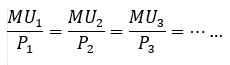
Where:
- MU = Marginal Utility
- P = Price
- The consumer reaches equilibrium when the ratio of MU to price is equal across all goods.
- Sample Problem:
*A consumer has ₦400 to spend on rice and beans.
- Rice: ₦100 per plate
- Beans: ₦50 per plate*
Marginal Utility (MU) Table:
|
Quantity |
MU of Rice |
MU of Beans |
|
1 |
40 |
30 |
|
2 |
35 |
25 |
|
3 |
25 |
20 |
|
4 |
15 |
15 |
Task:
- Allocate ₦400 to maximize utility.
- Use MU/P to determine best choice:
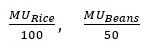
Solution:
Compute MU/P for each and spend where MU/P is highest.
For example:
- MU/P (Beans 1st unit) = 30/50 = 0.6
- MU/P (Rice 1st unit) = 40/100 = 0.4
- Beans gives higher satisfaction per naira → buy beans first.
Final Allocation (based on highest MU/P per ₦):
- 2 plates of beans = ₦100
- 3 plates of rice = ₦300
- Total = ₦400
Activities:
Group Work:
- Provide different price combinations and incomes.
- Learners solve for utility-maximizing combinations.
Individual Task:
- Create a table with personal spending and rate satisfaction (1–10)
- Analyze spending behavior using MU/P logic.
Experiment (Simulation Exercise):
Title: Budget Allocation Challenge
Materials: “Money” tokens, items with “prices” and MU values
Procedure:
- Give each group ₦300 in tokens
- Display 4 items with cost and MU
- Groups must spend to maximize utility
- Compare total satisfaction after allocation
Assessment Questions:
- What is the condition for consumer equilibrium?
- A consumer has ₦150 to spend on bread (₦30) and eggs (₦15). Use the table below to determine the optimal allocation:
|
Qty |
MU of Bread |
MU of Egg |
|
1 |
50 |
25 |
|
2 |
40 |
20 |
|
3 |
30 |
15 |
|
4 |
20 |
10 |
- Why should a consumer stop buying when MU/P becomes equal for all items?
Homework:
- Interview your parents or guardian about how they allocate limited income on food, transport, and clothing.
- Write how the principle of marginal utility explains their decisions.
Expanded Notes:
- Real-world application: Choosing data over extra food, buying 1 pair of shoes instead of 2 cheaper ones.
- Utility-maximizing rule helps firms price products attractively.
- Promotions and discounts aim to raise MU/P ratios to influence buyer behavior.
Differentiation:
- Simulations for kinesthetic learners
- Graphs and utility charts for visual learners
- Real-life budget problems for contextual learners
Teacher’s Reflection:
- Did learners understand the concept of maximizing utility?
- Were they able to use MU/P correctly?
- Were budget simulation activities engaging and effective?