Download the Lessonotes Mobile Liberia app for faster lesson access on Android and iPhone.


Subject: Economics
Semester: 2
Period: 4
Week: 23
School Name:
Teacher’s Name:
Subject: Economics
Grade Level: Grade 10
Week & Period: Week 23, Period IV
Date:
Topic: The Theory of Consumer Behavior
Sub-topic: Characteristics of the Indifference Curve, Budget Line & Consumer Surplus
Learning Objectives:
By the end of the lesson, learners should be able to:
- Identify and explain the characteristics of the indifference curve.
- Draw and interpret a budget line.
- Analyze the equilibrium between an indifference curve and a budget line.
- Define and explain the concept of consumer surplus with examples.
Instructional Materials:
- Graph papers
- Sample budget values
- Items with hypothetical prices
- Colored pencils and rulers
- Utility tables
- Flashcards with economic terms
Anticipation (Warm-Up):
Ask: "Have you ever bought something for less than the amount you were willing to pay? How did that make you feel?"
Introduce the concept of consumer surplus as the difference between what you’re willing to pay and what you actually pay.
Building Knowledge (Main Lesson):
- Characteristics of Indifference Curves (ICs):
- They slope downwards from left to right
- Convex to the origin (due to diminishing MRS)
- Do not intersect
- Higher curves show higher utility
- ICs are used to represent subjective preferences
- Budget Line:
- A budget line shows all combinations of two goods that a consumer can afford given their income and the prices of the goods.
Equation of the budget line:
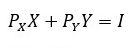
Where:
- = prices of goods X and Y
- X, Y = quantities of goods
- I = income
- Consumer Equilibrium:
- Occurs where the indifference curve is tangent to the budget line.
- At this point, the MRS equals the ratio of prices:

- Consumer Surplus:
- The extra benefit a consumer gets when they pay less than what they were willing to pay.
Formula:
Consumer Surplus=Maximum Price Willing to Pay−Actual Price Paid
Sample Problem (Consumer Surplus):
Mary is willing to pay ₦5,000 for a handbag. She buys it at ₦3,800.
What is her consumer surplus?
CS = ₦5,000 - ₦3,800 = ₦1,200
Mary gains ₦1,200 in satisfaction.
Activities:
- Group Activity:
- Each group gets a budget and two items to “buy” (e.g., snacks and drinks).
- Plot budget line and find points of maximum satisfaction.
- Discuss differences in spending priorities.
- Drawing Exercise:
- Learners draw their own budget lines and ICs to show consumer equilibrium.
Experiment (Simulation Exercise):
Title: Building Your Budget Line
Materials: Fake currency, item cards with prices, graph paper
Procedure:
- Each group is given ₦1,000 and 2 goods (e.g., pens ₦50, notebooks ₦100).
- Groups draw their budget line by calculating combinations they can afford.
- Then add an indifference curve where maximum satisfaction is reached.
Assessment Questions:
- List and explain any three characteristics of the indifference curve.
- Draw a well-labeled budget line for a student with ₦500 to spend on fruits (₦100 each) and drinks (₦50 each).
- What is consumer surplus? Give a real-life example.
- A buyer is willing to pay ₦10,000 for a phone but buys it at ₦7,500. Calculate the consumer surplus.
- Explain what happens when a budget line shifts outward.
Homework:
- Interview 2 friends/family members and ask them if they’ve ever experienced consumer surplus. Record their responses and share one in class.
- Using a hypothetical budget of ₦1,000, create your own budget line between two goods of your choice.
Expanded Notes:
- Shifts in Budget Line:
- An increase in income shifts the budget line outward.
- A price decrease for one good tilts the line.
- Consumer Surplus Applications:
- Sales promotions and discounts often increase consumer surplus.
- In public economics, it is used to measure welfare benefits.
Differentiation:
- Use storytelling to explain consumer surplus
- Hands-on simulation for kinesthetic learners
- Budget and utility graphing for visual learners
Teacher’s Reflection:
- Did students understand the visual relationship between IC and budget line?
- Were they able to calculate consumer surplus effectively?
- Did students enjoy and engage with the spending simulation?