Download the Lessonotes Mobile Liberia app for faster lesson access on Android and iPhone.


Subject: Physics
Semester: 2
Period: 5
Week: 26
School Name:
Teacher’s Name:
Subject: Physics
Grade Level: Grade 10
Week & Period: Week 26, Period V
Date:
Sub-topic: Coulomb’s Law of Electrostatics
Learning Objectives: By the end of the lesson, learners should be able to:
- State and explain Coulomb’s law.
- Solve numerical problems using Coulomb’s law.
- Understand how force varies with charge and distance.
- Describe experimental verification of Coulomb’s law.
Instructional Materials:
- Charged spheres (pith balls or metal-coated balls)
- Coulomb torsion balance model or animation
- Protractor
- Insulating threads and stands
- Rulers and calculators
Anticipation (Warm-Up): Ask: "Why do you think two charged balloons placed near each other sometimes push away from each other or come together?"
Building Knowledge:
- Coulomb’s Law Statement:
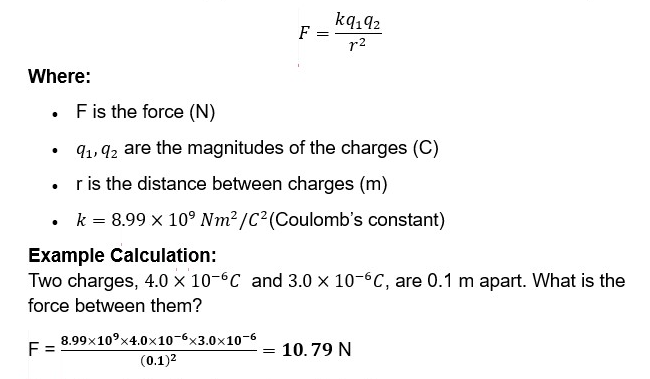
The electrostatic force (F) between two point charges is directly proportional to the product of the charges and inversely proportional to the square of the distance between them.
Experiment: Verification using pith balls:
- Suspend two similarly charged pith balls close to each other using insulating threads.
- Measure the repulsive force using angular deflection and apply calculations.
Activities:
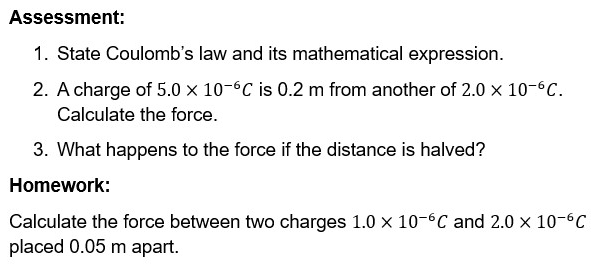
- Solve 3 numerical problems involving charges and varying distances.
- Use rulers and calculators to simulate charge interactions.
- Discuss what happens when distance doubles.
Expanded Notes:
- Electrostatic force acts along the line joining charges.
- It can be attractive or repulsive depending on the charges.
- The force increases greatly as distance decreases.
- The unit of charge is Coulomb (C), which is a large unit.
Differentiation:
- Visual learners use vector diagrams.
- Hands-on learners use simulations or animations.
- Group calculations for peer assistance.
Teacher’s Reflection:
- Were learners able to connect theory to practice?
- Did they correctly apply the formula?
- Should more visual aids or repetition be used?