Download the Lessonotes Mobile Liberia app for faster lesson access on Android and iPhone.


Subject: Physics
Semester: 2
Period: 5
Week: 27
School Name:
Teacher’s Name:
Subject: Physics
Grade Level: Grade 10
Week & Period: Week 27, Period V
Date:
Sub-topic: Electric Field and Potential Difference
Learning Objectives: By the end of the lesson, learners should be able to:
- Define electric field and potential difference.
- Explain the concept of electric field lines and their directions.
- Solve problems on electric field intensity.
- Distinguish between electric field and potential.
Instructional Materials:
- Charged rods
- Iron filings or semolina
- Transparent sheet
- Graph paper
- Van de Graaff generator (if available)
- Diagrams showing field patterns
Anticipation (Warm-Up): Ask: “Why does your hair stand when you touch a charged object? What invisible force is responsible?”
Building Knowledge:
- Electric Field: A region in space around a charged object where another charged object experiences a force.
- Electric Field Lines: Imaginary lines that show direction of electric force on a positive test charge.
- Lines originate from positive and terminate on negative charges.
- Field is stronger where lines are closer together.
- Electric Field Intensity (E): Where:
- is the force in Newtons (N)
- is the test charge in Coulombs (C)
- is the source charge
- is distance in meters (m)
- Potential Difference (V): Work done per unit charge to move a charge between two points.
V=W Unit: Volt (V)
q
Where:
- W is work done (Joules), q is charge (Coulombs)
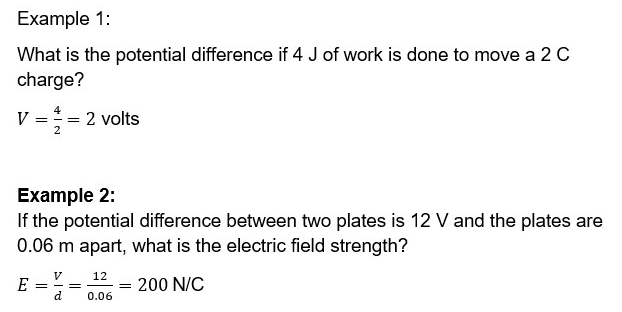
Experiment (Class Demo):
- Use a voltmeter to measure potential difference across a battery.
- Use parallel metal plates connected to a battery to show uniform field.
- Bring a small charged object near and watch field effect on light paper or metal foil.
Activities:
- Draw and label electric field lines for:
- A single positive charge
- A single negative charge
- A dipole
- Solve 3 potential difference problems
- Relate strength of field to spacing of field lines
Assessment:
- Define an electric field.
- Describe the appearance of field lines for a dipole.
- A 5 C charge is moved through 15 V. What work is done?
- Describe the difference between uniform and non-uniform electric fields.
Homework:
- Describe a real-life situation involving electric fields.
- Calculate the potential difference when 5 J of work moves a 2 C charge.
Expanded Notes:
- Electric fields are vector quantities.
- They determine how charges interact at a distance.
- Field lines never cross and represent direction of force.
- Potential difference is what drives electric current in circuits.
Differentiation:
- Use diagrams for visual learners.
- Hands-on field mapping for tactile learners.
- Role-play “test charges” for kinesthetic group.
Teacher’s Reflection:
- Did learners understand the invisible nature of electric fields?
- Were they able to relate field lines to force and direction?
- Should I reinforce the connection to circuits later?