Download the Lessonotes Mobile Liberia app for faster lesson access on Android and iPhone.


Subject: Physics
Semester: 2
Period: 5
Week: 28
School Name:
Teacher’s Name:
Subject: Physics
Grade Level: Grade 10
Week & Period: Week 28, Period V
Date:
Sub-topic: Electric Field Strength and Work Done in an Electric Field
Learning Objectives: By the end of the lesson, learners should be able to:
- Define electric field strength and state its unit.
- Solve numerical problems involving electric field strength and force.
- Define and calculate work done in moving a charge in an electric field.
- Explain the relationship between potential difference, field strength, and distance.
Instructional Materials:
- Whiteboard and marker
- Chart of electric field formulae
- Worksheets with field and work calculations
- Charged sphere models
- Van de Graaff generator
- Balloons and combs (for real-life demos)
Anticipation (Warm-Up): Pose a scenario: “Imagine a charged balloon near bits of paper. What invisible force moves them?” Transition into defining that force using field strength.
Building Knowledge:
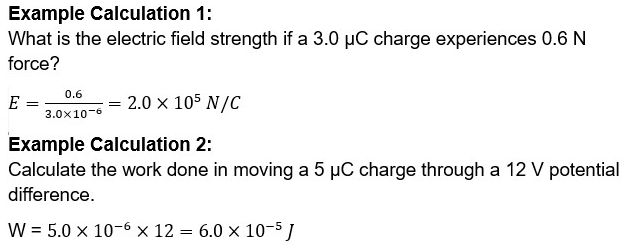
- Electric Field Strength (E): Force per unit charge in a field.
E= F (N/C)
q
Also:
E=V
d
- Work Done (W) in an Electric Field:
W= q×V
Where:
- q= charge (C), V= potential difference (V), W= work (Joules)
Activities:
- Solve 3 problems each for E = F/q and E = V/d.
- Calculate work done from worksheet problems.
- Real-life application: lightning bolt, static charges on clothes, etc.
Experiment (Demonstration):
- Use a Van de Graaff generator or charged balloons to move light materials.
- Observe how force (and by inference, field) is applied over a distance.
Assessment:
- Define electric field strength and its unit.
- A 2 µC charge experiences 0.5 N force. What is E?
- What work is done to move 3.0 µC charge through 10 V?
Homework:
- List 3 practical applications of electric field strength.
- Calculate E for a 9 V battery acting over 0.03 m.
Expanded Notes:
- Field strength shows how intense the force is.
- Stronger fields mean more force per charge.
- Work done is energy transferred, useful in electronics.
Differentiation:
- Use step-by-step breakdowns for numeracy-challenged learners.
- Group problem-solving.
- Connect formulas to prior experiments.
Teacher’s Reflection:
- Were learners able to distinguish between formulas?
- Could they apply E = V/d confidently?
- Should I revise work-energy concepts for clarity?