Download the Lessonotes Mobile Liberia app for faster lesson access on Android and iPhone.


Subject: Physics
Semester: 2
Period: 4
Week: 23
School Name:
Teacher’s Name:
Subject: Physics
Grade Level: Grade 10
Week & Period: Week 23, Period IV
Date:
Sub-topic: Gas Laws – Boyle’s, Charles’, and Combined Gas Laws
Learning Objectives:
By the end of the lesson, learners should be able to:
- State and explain Boyle’s, Charles’, and the Combined Gas Laws.
- Derive and apply the equations for each law.
- Solve numerical problems involving pressure, volume, and temperature.
- Describe how the gas laws relate to real-world phenomena.
Instructional Materials:
- Gas syringe
- Pressure pump or hand pump
- Balloons
- Ruler and stopwatch
- Bunsen burner / heat source
- Ice water bath
- Sealed transparent containers
- Thermometer
- Manometer
Anticipation (Warm-Up):
Ask: “Why do balloons expand when heated and shrink in the cold?”
Show a balloon in cold and warm water to spark curiosity.
Building Knowledge:
- Boyle’s Law – At constant temperature, the pressure of a gas is inversely proportional to its volume:
P∝1V⇒PV=constant
- If P1V1=P2V2 , then pressure and volume changes can be computed.
- Example: A gas has pressure 100 kPa and volume 2 L. What is the new volume if pressure is increased to 200 kPa?
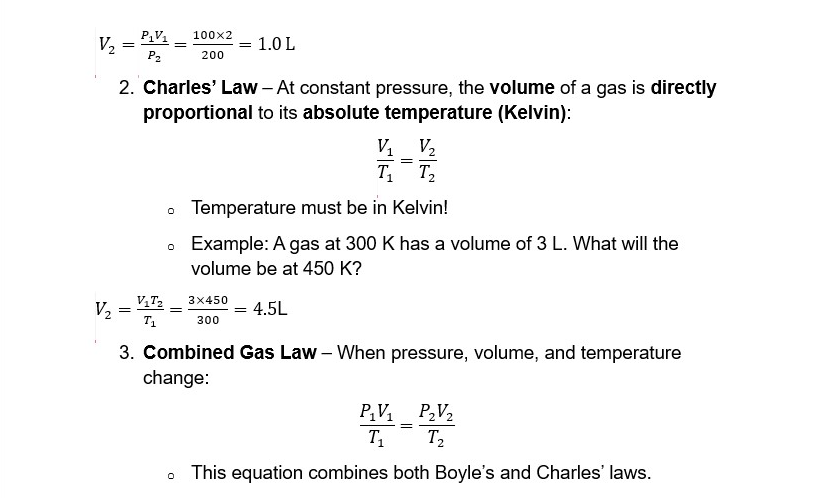
Experiments:
- Boyle’s Law Demonstration:
- Apparatus: Syringe, weight, pressure sensor (optional)
- Procedure:
Trap air inside syringe and seal it.
b. Apply pressure and measure change in volume.
c. Plot Pressure vs 1/Volume graph. - Expected Result: A straight line, confirming PV=constant
- Charles’ Law Demonstration:
- Apparatus: Balloon, boiling water, ice bath
- Procedure:
Place balloon in cold water – observe shrinkage.
b. Move to warm water – observe expansion.
c. Link to volume change with temperature.
Activities:
- Solve numerical problems using each gas law.
- In groups, design a chart summarizing all three gas laws with formulae and applications.
- Perform experiments with syringes and balloons to observe gas behavior.
Assessment:
- State Boyle’s Law and give the mathematical expression.
- A gas occupies 5 L at 25°C and 100 kPa. What volume will it occupy at 50°C and 200 kPa? (Use Combined Gas Law)
- If 2 L of gas at 300 K becomes 3 L, what is the new temperature?
Homework:
- Define all three gas laws with one practical application for each.
- Complete 5 numerical problems involving all laws.
Expanded Notes:
- Boyle’s Law applies when temperature is constant: e.g., deep sea diving and syringes.
- Charles’ Law applies when pressure is constant: e.g., hot air balloons.
- Combined Gas Law is the most versatile: use when multiple factors change.
- Always convert temperature to Kelvin in calculations.
Differentiation:
- Use animated simulations for abstract learners.
- Offer formula cards to memory-challenged learners.
- Conduct peer tutoring during problem-solving sessions.
Teacher’s Reflection:
- Did learners understand how each law applies in real life?
- Were they able to correctly use and rearrange formulas?
- Do they need more practice on identifying which law to apply?