Download the Lessonotes Mobile Liberia app for faster lesson access on Android and iPhone.


Subject: Chemistry
Semester: 2
Period: 4
Week: 22
School Name:
Teacher’s Name:
Subject: Chemistry
Grade Level: Grade 11
Week & Period: Week 22, Period IV
Date:
Topic: Electrolysis of Specific Compounds and Faraday’s Laws
Subtopics:
- Electrolysis of molten and aqueous compounds (NaCl, PbBr₂, CuSO₄, H₂SO₄, NaOH)
- Role of electrode type (Pt, graphite, copper)
- Faraday’s First and Second Laws of Electrolysis
Learning Objectives
By the end of this lesson, learners should be able to:
- Identify the products formed in the electrolysis of common compounds
- Explain how the type of electrode influences the electrolysis outcome
- State and apply Faraday’s First and Second Laws of Electrolysis
- Solve simple problems involving mass, charge, and moles in electrolysis
Previous Knowledge
Learners are already familiar with basic electrolysis principles, ion discharge, and electrode reactions.
Instructional Materials:
- Electrolysis diagrams for molten and aqueous systems
- Faraday’s laws formula sheet
- Sample calculations and conversion chart (Coulombs, moles, grams)
- Videos/demos of electrolysis with different electrodes
Anticipation (Warm-Up) – 5 minutes
Pose the question: “Why is more copper deposited when electrolysis runs longer?”
Use this to introduce Faraday’s laws and time-current-mass relationships.
Building Knowledge (Main Lesson) – 25 minutes
- Electrolysis of Specific Compounds
- Molten NaCl
- Products: Na (cathode), Cl₂ (anode)
- PbBr₂
- Products: Pb (cathode), Br₂ (anode)
- Dilute NaCl (aq)
- Products: H₂ (cathode), Cl₂ (anode)
- Concentrated NaCl (aq)
- Products: H₂ (cathode), Cl₂ (anode); NaOH remains in solution
- CuSO₄ with graphite electrodes
- Products: Cu (cathode), O₂ (anode)
- CuSO₄ with copper electrodes
- Copper dissolves at the anode and deposits at the cathode (mass transfer)
- Dilute H₂SO₄
- Products: H₂ (cathode), O₂ (anode)
- NaOH (Pt or graphite)
- Similar to H₂SO₄ (H₂ and O₂)
- Role of Electrode Material
- Graphite/Pt (inert): Do not react but provide surfaces for redox
- Copper (active): Participates in reaction (oxidized at anode)
- Faraday’s Laws of Electrolysis
- First Law: Mass of substance produced ∝ quantity of electricity
m=Q⋅Mn⋅Fm = \frac{Q \cdot M}{n \cdot F}m=n⋅FQ⋅M - Second Law: Different substances liberated by same quantity of electricity are proportional to their equivalent weights
- Introduce terms: Faraday (F = 96,500 C), molar mass (M), number of electrons (n), current (I), time (t), and charge (Q)
- Sample Problem Solving
- Example: Calculate mass of copper deposited using given current and time
- Convert current and time into total charge (Q = I × t)
- Use formula to find mass
Learners’ Activities
- Match compounds with expected electrolysis products
- Complete worksheet with Faraday’s law problems
- Compare results for inert vs active electrodes in a table
- Observe video demo or diagram of molten vs aqueous electrolysis
Consolidation (Review and Assessment) – 10 minutes
- Exit quiz: Predict anode/cathode products for given compounds
- Solve one guided Faraday’s law problem on the board
- Peer discussion: What happens if we change electrode material?
Homework / Assignment
- Write equations for anode and cathode reactions in:
CuSO₄ (graphite)
b. PbBr₂ (molten) - Calculate the mass of copper deposited when 0.5 A current flows for 20 minutes
- Explain why Na is not obtained during the electrolysis of aqueous NaCl
Notes – Detailed and Explained
Electrolysis of Common Compounds depends on the physical state and concentration of the electrolyte, as well as electrode type. In molten compounds, only metal and non-metal ions exist, while aqueous solutions involve competition with H⁺ and OH⁻ from water.
Inert Electrodes like graphite and platinum don’t participate in the reaction. Active electrodes like copper do — the anode loses metal ions which are deposited at the cathode.
Faraday’s First Law quantifies the relationship between the mass of substance deposited and the electric charge passed through the electrolyte.
Faraday’s Second Law shows that substances with higher equivalent weight require more charge to produce the same amount.
Formula:
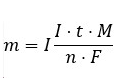
Where:
- m = mass deposited
- I = current in amperes
- t = time in seconds
- M = molar mass
- n = number of electrons exchanged
- F = Faraday’s constant (96,500 C/mol e⁻)
Expanded Notes / Instructions
- Reinforce ionic charges and half-reactions
- Use real-world connections (e.g., electrorefining, electroplating)
- Provide calculation scaffolds for learners needing extra help
Inclusive / Differentiation
- Visual learners: equation diagrams and annotated reactions
- Practice questions of varying difficulty
- Challenge group: reverse-engineer unknowns from mass data
Teacher’s Reflection (Post-Lesson Questions)
- Were learners able to balance redox reactions and calculate masses?
- Did they understand the connection between electricity and chemistry?
- Should I revisit molar and equivalent mass concepts in the next lesson?