Download the Lessonotes Mobile Liberia app for faster lesson access on Android and iPhone.


Subject: Mathematics
Semester: 2
Period: 5
Week: 25
WEEK 25
Class: Grade 11
Age: 16 years
Duration: 40 minutes for 5 periods
Subject: Mathematics
Topic: The Right-Angle Triangle - Angles of Elevation and Depression
Specific Objectives:
By the end of the lesson, students should be able to:
- Understand the concept of angles of elevation and depression.
- Draw diagrams representing angles of elevation and depression.
- Apply trigonometric ratios (sine, cosine) to solve problems involving angles of elevation and depression.
- Solve real-life problems involving angles of elevation and depression.
Instructional Techniques:
- Teacher-guided demonstration
- Question and answer
- Class discussion
- Guided practice
- Problem-solving
Instructional Materials:
- Whiteboard and markers
- Diagram of a tree and student standing on a desk (for real-life illustration)
- Protractors for measuring angles
- Rulers for drawing diagrams
PERIOD 1 & 2: Introduction to Angles of Elevation and Depression
Presentation:
|
Step |
Teacher’s Activity |
Student’s Activity |
|
Step 1: Introduction to Angles |
Introduces the concepts of angles of elevation and depression. Defines angles of elevation (when the observer looks upward) and depression (when the observer looks downward). Uses the diagram of a tree and a student on a desk to demonstrate these angles. |
Students listen attentively and take notes. They ask questions for clarification if needed. |
|
Step 2: Drawing Diagrams |
Demonstrates how to draw angles of elevation and depression using the tree and student diagram. Shows how the observer's eye level is important in determining the angle. |
Students practice drawing their own diagrams with angles of elevation and depression. |
|
Step 3: Real-Life Application |
Explains how angles of elevation and depression are used in real-life scenarios like measuring the height of a building or the distance to a far object. |
Students discuss the applications and give examples from their own experiences. |
Note on Board:
- Angle of Elevation: The angle between the line of sight and the horizontal line when looking upward.
- Angle of Depression: The angle between the line of sight and the horizontal line when looking downward.
- Both angles are measured from the horizontal ground.
Evaluation (5 Exercises):
- What is the difference between the angle of elevation and the angle of depression?
- What type of diagram would you draw to illustrate the angle of depression from the top of a tower to a point on the ground?
- Define the angle of elevation with a real-life example.
- What is the role of the observer's eye level in determining angles of elevation and depression?
- In which situation would you use the angle of depression to measure height?
Classwork (5 Questions):
- Draw a diagram showing the angle of elevation from a student standing on a desk to a tree.
- Draw a diagram showing the angle of depression from the top of a building to a point on the ground.
- Label the horizontal line and angle of depression in your diagram.
- What is the angle of depression if a bird flying 50 meters above the ground looks down at a point 200 meters away?
- What can you infer about the angle of depression if a person standing on a mountain top looks down at a point far below?
Assignment (5 Tasks):
- Draw a diagram illustrating the angle of depression from the top of a skyscraper to a car parked at its base.
- Measure the angle of elevation from a given point in your surroundings to the top of a tall building.
- Calculate the angle of depression if the height of a tower is 30 meters, and the distance from the base to the observer is 60 meters.
- Explain how the concepts of angles of elevation and depression can be applied in surveying.
- Use a protractor to find the angle of elevation to the top of a tree from a certain distance.
PERIOD 3 & 4: Application of Trigonometric Ratios to Solve Problems
Presentation:
|
Step |
Teacher’s Activity |
Student’s Activity |
|
Step 1: Introduction to Trigonometric Ratios |
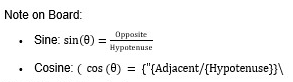
Introduces trigonometric ratios (sine, cosine) in relation to right-angle triangles. Explains how to use these ratios to solve for unknown sides or angles in problems involving elevation and depression. |
Students take notes and prepare for solving problems using trigonometry. |
|
Step 2: Solving with Trigonometric Ratios |
Demonstrates solving problems involving angles of elevation and depression using sine and cosine ratios. For example, using sine to calculate height or cosine to find distance. |
Students follow along with the teacher’s demonstration. |
|
Step 3: Guided Practice |
Provides students with practice problems on angles of elevation and depression, guiding them step-by-step to use trigonometric ratios. |
Students practice in pairs or small groups with teacher assistance. |
Evaluation (5 Exercises):
- Solve for the height of a building if the angle of elevation is 30° and the distance from the observer is 50 meters.
- Calculate the distance from a point to the base of a mountain if the angle of depression is 45° and the height of the mountain is 200 meters.
- If the angle of elevation to a tree is 60° and the distance from the observer is 80 meters, find the height of the tree.
- Find the angle of elevation from a point 100 meters from a tower to its top. The height of the tower is 60 meters.
- Calculate the angle of depression from the top of a hill to a point 150 meters below.
Classwork (5 Questions):
- Using the sine rule, find the height of a tree given an angle of elevation of 40° and a distance of 30 meters from the tree.
- Solve for the angle of depression given a 20-meter height and a 50-meter horizontal distance.
- Use cosine to find the distance from a point to the base of a building. The angle of elevation is 30°, and the building height is 45 meters.
- Calculate the height of a lighthouse if the angle of elevation is 45° and the distance is 120 meters.
- Apply trigonometric ratios to solve for an unknown angle in an angle of elevation problem.
Assignment (5 Tasks):
- Solve a real-world problem using trigonometric ratios involving the height of a building and angle of elevation.
- Calculate the angle of depression for a lighthouse with a height of 50 meters and a boat 200 meters away.
- Find the height of a tree if the angle of elevation is 35° and the distance from the tree is 40 meters.
- Solve for the distance between a tower and a point 100 meters away, with an angle of elevation of 25°.
- Create a word problem involving angles of elevation and depression and solve it using trigonometric ratios.
PERIOD 5: Final Application and Consolidation
Presentation:
|
Step |
Teacher’s Activity |
Student’s Activity |
|
Step 1: Recap and Reinforcement |
Recaps the concepts of angles of elevation and depression. Guides students through one more complex problem involving both angles and trigonometric ratios. |
Students follow the teacher’s walkthrough and ask any remaining questions. |
|
Step 2: Independent Practice |
Provides a set of mixed problems on angles of elevation, depression, and trigonometric ratios for students to complete independently. |
Students solve problems independently while the teacher circulates to assist. |
|
Step 3: Discussion |
Discusses the solutions to the problems and clarifies any misunderstandings. |
Students share their solutions and understanding of the lesson. |
Evaluation (5 Exercises):
- Solve for the height of a mountain given an angle of elevation of 30° and a distance of 200 meters.
- Calculate the angle of depression if the distance to the base of a building is 100 meters and the height is 50 meters.
- Use trigonometric ratios to find the angle of elevation given a height of 30 meters and a distance of 40 meters.
- Find the distance from a point to the top of a hill with an angle of elevation of 50° and a height of 100 meters.
- Solve for the height of a flagpole given a 60° angle of elevation and a 100-meter distance from the observer.