Download the Lessonotes Mobile Liberia app for faster lesson access on Android and iPhone.


Subject: Mathematics
Semester: 2
Period: 4
Week: 23
Week 23
Class: Grade 11
Age: 16 years
Duration: 40 minutes per period (5 periods)
Subject: Mathematics
Topic: Trigonometry (I)
Focus: Derivation of Sine Rule and Its Application, Derivation of Cosine Rule and Its Application
Specific Objectives:
By the end of the lesson, students should be able to:
- Derive the sine rule and apply it in solving problems.
- Derive the cosine rule and apply it in solving problems.
- Understand the relationship between angles and sides of a triangle using sine and cosine rules.
Instructional Techniques:
- Question and Answer
- Guided Demonstration
- Discussion
- Practice Exercises
- Use of Charts and Visual Aids
Instructional Materials:
- Acute angle chart
- Obtuse-angled triangle chart
- Whiteboard and markers
- Rulers and protractors
- Trigonometry tables for reference
- Worksheet for sine and cosine rule problems
Period 1 & 2: Derivation of the Sine Rule and Its Application
Presentation:
|
Step |
Teacher's Activity |
Student’s Activity |
|
Step 1 - Introduction |
Introduces the concept of the sine rule in a triangle. Displays a chart of an acute-angled triangle. |
Students observe the chart and listen to the teacher’s explanation. |
|
Step 2 - Derivation of the Sine Rule |
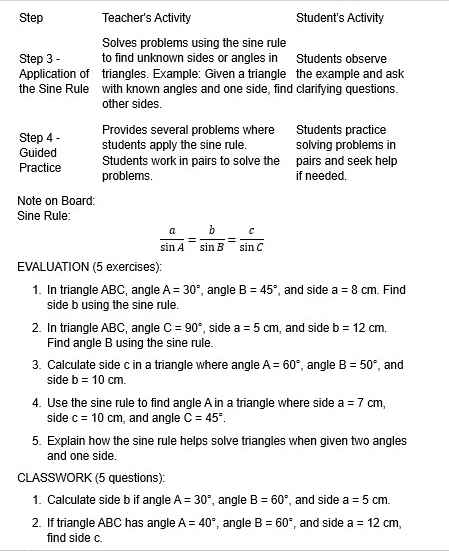
Guides students to identify corresponding angles and sides in a triangle. Derives the sine rule from the law of sines: a/sinA = b/sinB = c/sinC. |
Students follow the teacher’s steps and take notes on the derivation. |
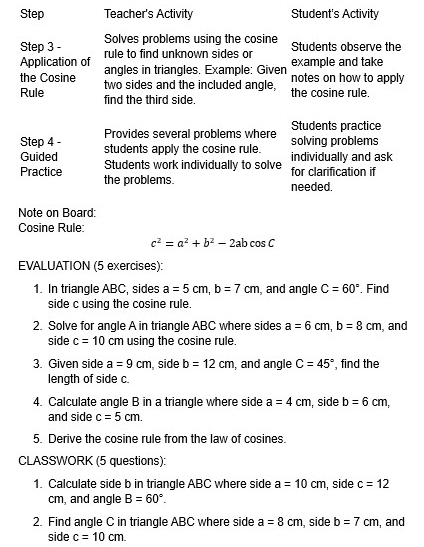
3. Solve for side c in triangle ABC where side a = 15 cm, side b = 20 cm, and angle C = 120°.
4. Solve for angle A in triangle ABC where side a = 7 cm, side b = 8 cm, and side c = 9 cm.
5. Calculate side a in a triangle where side b = 11 cm, side c = 13 cm, and angle C = 90°.
ASSIGNMENT (5 tasks):
- Solve for angle B in triangle ABC where sides a = 10 cm, b = 15 cm, and angle C = 120°.
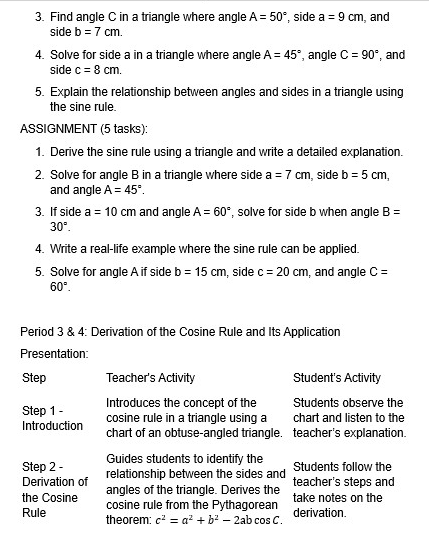
- Derive the cosine rule from the law of cosines and provide examples of its application.
- Solve for side b in a triangle where side a = 9 cm, side c = 14 cm, and angle C = 60°.
- If side a = 5 cm, side b = 7 cm, and angle A = 60°, find angle B using the cosine rule.
- Provide a real-life scenario where the cosine rule can be applied.
Period 5: Consolidation and Practice
Presentation:
- Review the sine and cosine rules.
- Engage students in solving combined problems that require both sine and cosine rules.
- Ensure students understand when to use each rule based on the given information.
EVALUATION (5 exercises):
- Solve for side c in triangle ABC using both the sine and cosine rules.
- Solve for angle A in a triangle where sides a = 12 cm, b = 10 cm, and angle C = 60°.
- Use both sine and cosine rules to solve a triangle where angles A = 40°, B = 60°, and side a = 8 cm.
- Derive both the sine and cosine rules from the basic principles of trigonometry.
- Solve a real-life problem using either the sine or cosine rule.