Download the Lessonotes Mobile Liberia app for faster lesson access on Android and iPhone.


Subject: Physics
Semester: 1
Period: 3
Week: 16
School Name:
Teacher’s Name:
Subject: Physics
Grade Level: Grade 11
Week & Period: Week 16, Period III
Date:
Sub-topic: Angular Momentum and Its Conservation
Learning Objectives:
By the end of this lesson, learners should be able to:
- Define angular momentum and its SI unit.
- Distinguish between linear and angular momentum.
- State and apply the law of conservation of angular momentum.
- Solve problems involving angular momentum.
- Identify real-world applications of angular momentum conservation.
Previous Knowledge:
Students understand linear momentum and its conservation from Weeks 13–15.
Instructional Materials:
- Rotating platform (lazy Susan or swivel stool)
- Dumbbells or small weights
- Meter rule
- Stopwatch
- String and masses
- Visuals of figure skaters, satellites, rotating fans
Anticipation (Warm-Up):
Ask learners:
- "Why does a spinning figure skater spin faster when pulling their arms in?"
- "Why do stars spin faster as they collapse into neutron stars?"
Short demo: Learner stands on rotating chair holding weights. As they pull weights inward, rotation speeds up.
Building Knowledge (Main Lesson) – 25 minutes
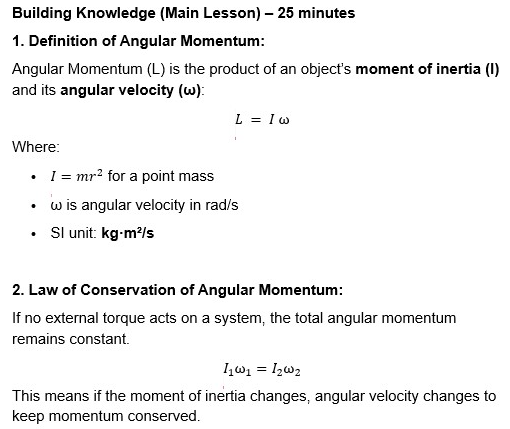
- Differences Between Linear and Angular Momentum:
|
Feature |
Linear Momentum |
Angular Momentum |
|
Equation |
p=mv |
L=Iω |
|
Unit |
kg·m/s |
kg·m²/s |
|
Vector Direction |
Along motion |
Perpendicular to plane of rotation |
|
External Agent |
Force |
Torque |
Worked Example:
Problem:
A student standing on a frictionless rotating platform with arms extended has a moment of inertia of 4.0 kg·m² and is rotating at 2 rad/s. When the student pulls in their arms, the moment of inertia becomes 2.0 kg·m². What is the new angular velocity?
Solution:

Experiment:
Title: Conservation of Angular Momentum Using a Swivel Chair
Materials:
- Swivel chair or rotating stool
- Two dumbbells or equal masses
- Stopwatch (optional)
Procedure:
- Student sits on rotating chair holding weights with arms stretched.
- Rotate gently and ask student to pull arms in.
- Observe increase in rotation speed.
Observation:
Rotation becomes faster as moment of inertia decreases. Angular momentum remains conserved.
Learners’ Activities:
- Solve angular momentum problems from textbook.
- Perform rotating chair demonstration in groups.
- Identify applications in space, sports, or machinery.
Consolidation (Review and Assessment) – 10 minutes
Oral Questions:
- What is angular momentum?
- How is it different from linear momentum?
- What happens to angular velocity when a spinning body reduces its radius?
Homework / Assignment:
- A spinning disk with moment of inertia 10 kg·m² rotates at 5 rad/s. What is its angular momentum?
- Research 3 real-life situations where angular momentum is conserved.
Notes – Detailed and Explained:
- Angular momentum applies to all rotating objects.
- Moment of inertia depends on mass distribution.
- Conservation principle is critical in satellites, skaters, collapsing stars, wind turbines.
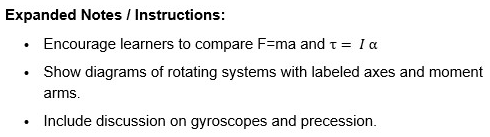
- Torque is to angular motion what force is to linear motion.
Differentiation:
- Visual: diagrams, rotation videos
- Kinesthetic: chair rotation demo
- Auditory: group discussions and guided solving
Teacher’s Reflection:
- Did learners grasp the relationship between moment of inertia and velocity?
- Were they able to apply conservation principles in problem-solving?
- Should real-life applications be emphasized more?