Download the Lessonotes Mobile Liberia app for faster lesson access on Android and iPhone.


Subject: Physics
Semester: 1
Period: 1
Week: 4
School Name:
Teacher’s Name:
Subject: Physics
Grade Level: Grade 11
Week & Period: Week 4, Period I
Date:
Sub-topic: Circular Motion
Learning Objectives
By the end of this lesson, learners should be able to:
- Define circular motion and distinguish between uniform and non-uniform circular motion.
- Explain centripetal force and centripetal acceleration.
- Calculate centripetal force, velocity, and acceleration in uniform circular motion.
- Identify examples and applications of circular motion.
Previous Knowledge
Learners should understand basic motion concepts, vectors, and forces.
Instructional Materials
- String and rubber stopper (for demonstration)
- Stopwatch
- Meter rule
- Spring balance
- Whiteboard and markers
Anticipation (Warm-Up) – 5 minutes
Ask:
- “What happens when you swing a stone tied to a string in a circle?”
- “What keeps the stone moving in a circle?”
Lead to discussion on forces involved in circular motion.
Building Knowledge (Main Lesson) – 25 minutes
- Definition:
- Circular motion: Movement of an object along a circular path.
- Types:
- Uniform circular motion: Speed is constant but direction changes continuously.
- Non-uniform circular motion: Speed changes as the object moves around the circle.
- Centripetal Force:
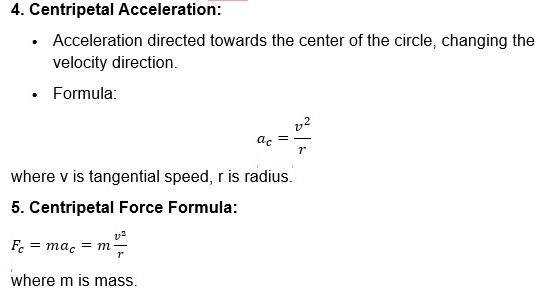
- The inward force that keeps an object moving in a circle, directed towards the center.
- Examples: tension in string, gravitational force, friction.
Consolidation (Review and Assessment) – 10 minutes
Oral Questions:
- What direction does centripetal force act?
- Calculate centripetal acceleration for a car moving at 20 m/s around a curve of radius 50 m.
- Why does the stone not fly off tangentially when swung in a circle?
Homework / Assignment
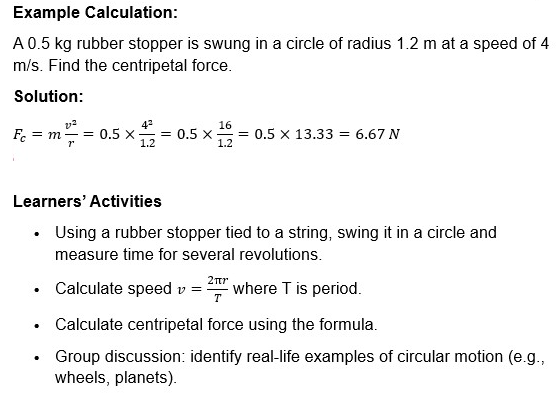
- A car of mass 1000 kg moves at 15 m/s around a curve of radius 25 m. Calculate centripetal force.
- List 5 examples of circular motion from daily life.
Notes – Detailed and Explained
- Circular motion involves continuous change of velocity direction, hence acceleration.
- Centripetal force is essential to maintain circular motion, acting towards the center.
- Uniform circular motion has constant speed but changing velocity vector due to direction change.
- Centripetal force can arise from tension, gravity, friction, or other forces depending on context.
Expanded Notes / Instructions
- Demonstrate experimentally with string and stopper for kinesthetic learning.
- Emphasize distinction between centripetal force (center-seeking) and centrifugal effect (apparent outward force).
Inclusive / Differentiation
- Use hands-on experiments for tactile learners.
- Visual diagrams and animations to show force directions.
- Stepwise problem solving for learners needing extra support.
Teacher’s Reflection (Post-Lesson Questions)
- Were learners able to grasp centripetal force concept clearly?
- Did the experiment clarify the theory?
- How well did learners perform in calculating centripetal force and acceleration?