Download the Lessonotes Mobile Liberia app for faster lesson access on Android and iPhone.


Subject: Physics
Semester: 1
Period: 2
Week: 7
School Name:
Teacher’s Name:
Subject: Physics
Grade Level: Grade 11
Week & Period: Week 7, Period II
Date:
Sub-topic: Composition and Equilibrium of Forces
Learning Objectives
By the end of this lesson, learners should be able to:
- Combine force vectors to find the resultant force.
- Define equilibrium and state the two conditions of equilibrium.
- Differentiate between resultant and equilibrant forces.
Previous Knowledge
Students should be familiar with forces as vectors and basic vector addition.
Instructional Materials
- Force boards or wooden boards with pins
- Springs or spring balances
- Protractors
- String and weights
- Whiteboard and markers
Anticipation (Warm-Up) – 5 minutes
Ask:
- “What happens when two forces act on an object in different directions?”
- “How do we find the combined effect of these forces?”
Building Knowledge (Main Lesson) – 25 minutes
- Composition of Forces:
- Forces acting at a point can be combined into a single force called the resultant force.
- Methods: graphical (parallelogram) and analytical (component method).
- Equilibrium of Forces:
- An object is in equilibrium when the resultant force acting on it is zero.
- Conditions for equilibrium:
- The vector sum of all forces equals zero (translational equilibrium).
- The sum of all moments (torques) about any point is zero (rotational equilibrium).
- Resultant vs Equilibrant:
- The resultant force is the single force that replaces the effect of all forces acting on the object.
- The equilibrant force is equal in magnitude but opposite in direction to the resultant force, maintaining equilibrium.
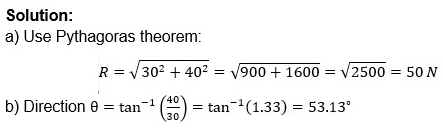
Example Calculation:
Two forces of 30 N and 40 N act at a point at 90°. Find:
a) The magnitude of the resultant force.
b) The direction of the resultant relative to the 30 N force.
Learners’ Activities
- Use spring balances at different angles to measure forces acting at a point.
- Draw force diagrams and calculate resultants graphically and analytically.
- Discuss everyday examples of equilibrium (e.g., hanging pictures).
Consolidation (Review and Assessment) – 10 minutes
Oral Questions:
- Define resultant and equilibrant forces.
- State the two conditions for equilibrium.
- Calculate resultant force when two forces of 20 N and 15 N act at 60°.
Homework / Assignment
- A box is pulled by two forces of 50 N and 70 N at 120° apart. Calculate the resultant force.
- Identify three examples of equilibrium in real life.
Notes – Detailed and Explained
- Forces add vectorially; their resultant determines motion.
- Equilibrium means no net force or torque acts, so the object is at rest or moves uniformly.
- Resultant and equilibrant are opposite forces related to equilibrium conditions.
Expanded Notes / Instructions
- Use diagrams to illustrate vector addition.
- Reinforce understanding by physically demonstrating forces using springs and strings.
Inclusive / Differentiation
- Visual demonstrations for learners who benefit from seeing concepts.
- Group problem-solving for collaborative learners.
- Stepwise calculations for learners needing extra support.
Teacher’s Reflection
- Did learners understand vector addition of forces?
- Were equilibrium conditions clear?
- Did the practical activities help clarify concepts?