Download the Lessonotes Mobile Liberia app for faster lesson access on Android and iPhone.


Subject: Physics
Semester: 1
Period: 2
Week: 8
School Name:
Teacher’s Name:
Subject: Physics
Grade Level: Grade 11
Week & Period: Week 8, Period II
Date:
Sub-topic: Composition and Resolution of Forces Using Cosine and Sine Laws
Learning Objectives
By the end of this lesson, learners should be able to:
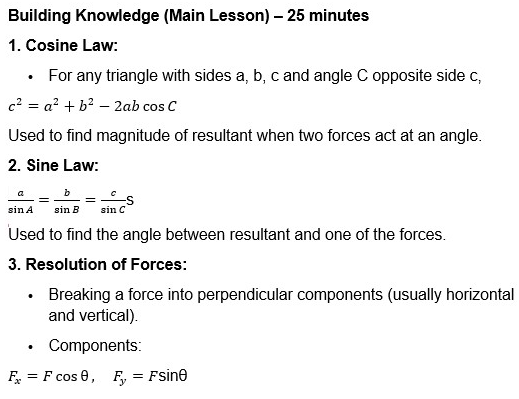
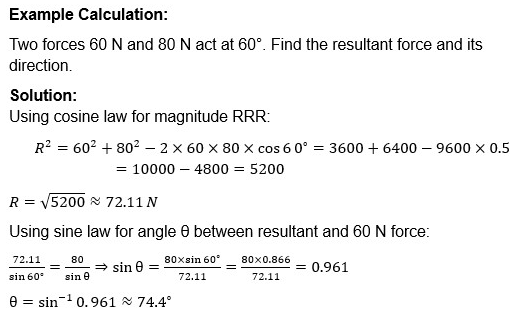
- Use the cosine law to calculate the magnitude of the resultant force.
- Use the sine law to calculate the direction of the resultant force.
- Resolve forces into components along given axes.
Previous Knowledge
Students should know basic trigonometry (sine, cosine laws) and vector components.
Instructional Materials
- Protractors
- Rulers
- Calculators
- Whiteboard
Anticipation (Warm-Up) – 5 minutes
Ask:
- “How do we find unknown sides or angles in force triangles?”
- Review sine and cosine laws.
Building Knowledge (Main Lesson) – 25 minutes
Learners’ Activities
- Solve vector triangles using sine and cosine laws.
- Practice resolving forces into components with different angles.
Consolidation (Review and Assessment) – 10 minutes
Oral Questions:
- State the cosine and sine laws.
- Calculate the components of a 100 N force acting at 30°.
- Find the magnitude and direction of resultant force for two forces of 40 N and 50 N at 90°.
Homework / Assignment
- Two forces of 70 N and 90 N act at 45°. Calculate resultant and angle with 70 N force.
- Resolve a force of 150 N acting at 60° into horizontal and vertical components.
Notes – Detailed and Explained
- Cosine law applies when you know two sides and included angle or all three sides.
- Sine law helps find unknown angles or sides in oblique triangles.
- Force resolution simplifies analysis by dealing with components.
Expanded Notes / Instructions
- Use diagrammatic approaches alongside formulas.
- Provide guided examples before independent practice.
Inclusive / Differentiation
- Use physical models to illustrate vector triangles.
- Break down problems into manageable steps.
Teacher’s Reflection
- Did learners successfully apply sine and cosine laws?
- Was force resolution clearly understood?