Download the Lessonotes Mobile Liberia app for faster lesson access on Android and iPhone.


Subject: Physics
Semester: 1
Period: 3
Week: 15
School Name:
Teacher’s Name:
Subject: Physics
Grade Level: Grade 11
Week & Period: Week 15, Period III
Date:
Sub-topic: Conservation of Linear Momentum
Learning Objectives:
By the end of this lesson, learners should be able to:
- State the law of conservation of linear momentum.
- Apply the law to various collision and explosion scenarios.
- Solve numerical problems involving conservation of momentum.
- Explain practical applications of momentum conservation.
Previous Knowledge:
Learners understand linear momentum, impulse, and types of collisions from previous lessons.
Instructional Materials:
- Dynamics carts
- Ballistic pendulum
- Spring-loaded launcher
- Stopwatch
- Meter rule
- Graph sheets
- Weights
Anticipation (Warm-Up):
Pose this scenario:
“If you fire a gun, what happens to the gun itself?”
(Demonstrates the principle of recoil as momentum conservation.)
Building Knowledge (Main Lesson) – 25 minutes
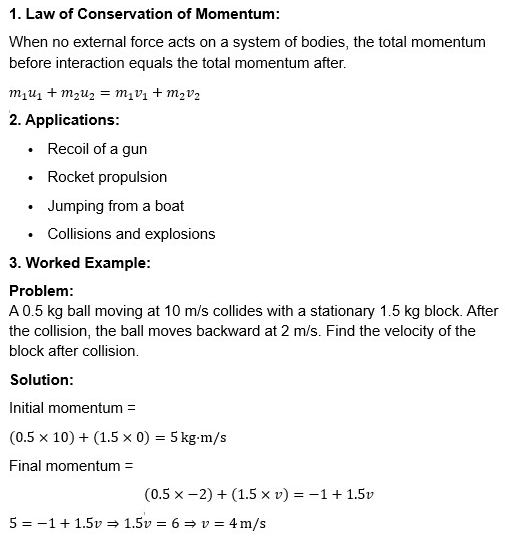
Experiment:
Title: Verifying Conservation of Momentum Using Dynamics Carts
Materials:
- 2 dynamics carts
- Smooth surface track
- Masses
- Spring-loaded plunger
- Stopwatch, meter rule
Procedure:
- Place carts on track, one loaded with spring plunger.
- Measure mass and initial velocities (one is stationary).
- Release spring to initiate collision.
- Measure final velocities.
- Compare total momentum before and after.
Expected Result:
Total momentum before ≈ Total momentum after (within margin of error)
Learners’ Activities:
- Work in pairs to simulate recoil using mass and trolleys.
- Solve 3 numerical problems on momentum conservation.
- Complete a momentum before/after diagram from provided data.
Consolidation (Review and Assessment) – 10 minutes
Oral Questions:
- State the law of conservation of momentum.
- In which direction does the gun move after being fired?
- Why is it easier to move a light object quickly than a heavy one?
Homework / Assignment:
- Solve: A firework of 2 kg explodes into two parts of 0.5 kg and 1.5 kg. If the smaller part moves at 12 m/s, what is the velocity of the other?
- Research: Explain how conservation of momentum applies to rocket launch.
Notes – Detailed and Explained:
- Momentum is a vector quantity; direction matters.
- In a closed system, internal forces (like explosions or collisions) do not change total momentum.
- Real-life applications:
- Rocket launches: mass ejected downward gives upward motion.
- Collisions: Car crash analysis
- Recoil in weapons: action and reaction
Expanded Notes / Instructions:
- Emphasize Newton’s 3rd Law: action and reaction pairs relate to momentum conservation.
- Show graphical representation: momentum vs. time graphs
- Guide through impulse-momentum connection
Differentiation:
- Group learners for practicals: use real carts or simulations
- Visual learners: Draw before-after momentum diagrams
- High-achievers: Challenge with 2D momentum problems
Teacher’s Reflection:
- Were learners able to differentiate between elastic/inelastic momentum conservation?
- Did all learners participate in experiments?
- Should I revisit vector addition of velocities?