Download the Lessonotes Mobile Liberia app for faster lesson access on Android and iPhone.


Subject: Physics
Semester: 1
Period: 3
Week: 14
School Name:
Teacher’s Name:
Subject: Physics
Grade Level: Grade 11
Week & Period: Week 14, Period III
Date:
Sub-topic: Elastic and Inelastic Collisions
Learning Objectives:
By the end of this lesson, learners should be able to:
- Define elastic and inelastic collisions.
- Compare characteristics of elastic and inelastic collisions.
- Apply conservation of momentum in solving problems involving both types of collisions.
- Analyze simple collision scenarios mathematically.
Previous Knowledge:
Students understand linear momentum and impulse from Week 13.
Instructional Materials:
- Smooth horizontal air track or low-friction carts
- Weights or blocks
- Motion sensors or stopwatches
- Rulers or meter rules
- Graph sheets
Anticipation (Warm-Up):
Ask:
- “What happens when two moving cars crash and stick together?”
- “Is energy always conserved in a collision?”
Brief demonstration: Two carts on a smooth table. One cart is pushed to collide with another (stick together for inelastic, bounce off for elastic). Observe and discuss outcomes.
Building Knowledge (Main Lesson) – 25 minutes
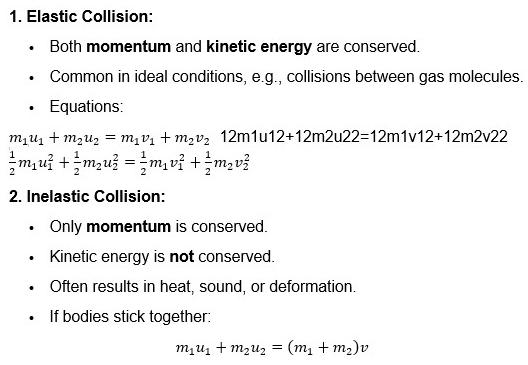
- Comparison Table:
|
Feature |
Elastic Collision |
Inelastic Collision |
|
Momentum conserved |
Yes |
Yes |
|
Kinetic energy conserved |
Yes |
No |
|
Post-collision motion |
Bodies separate |
May stick together |
Worked Examples:
Example 1 (Elastic):
Two balls of mass 2 kg and 3 kg move towards each other at 4 m/s and -2 m/s respectively. They collide elastically. Find their velocities after collision.
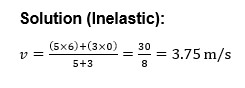
Example 2 (Inelastic):
A 5 kg body moving at 6 m/s collides with a 3 kg stationary body. They stick together. Find their final velocity.
Experiment:
Title: Investigating Elastic and Inelastic Collisions
Materials:
- Two dynamics carts
- Masses
- Smooth surface or air track
- Stopwatch, meter rule
Procedure:
- Push two carts towards each other and allow them to collide.
- Record velocities before and after collision.
- Use different conditions to observe elastic vs inelastic effects.
- Calculate momentum and kinetic energy before and after.
Learners’ Activities:
- Draw before and after diagrams for both types of collisions.
- Solve two given scenarios involving elastic and inelastic collisions.
- Calculate loss of kinetic energy in inelastic collision.
Consolidation (Review and Assessment) – 10 minutes
Oral Questions:
- What is conserved in an elastic collision?
- What happens to kinetic energy in an inelastic collision?
- Can two objects stick together in an elastic collision?
Homework / Assignment:
- Solve: A 2 kg cart moving at 3 m/s collides and sticks with a 4 kg stationary cart. Find final velocity.
- Research and report two real-life examples of inelastic collisions.
Notes – Detailed and Explained:
- Elastic collisions conserve both momentum and kinetic energy.
- In real life, perfect elastic collisions are rare.
- Inelastic collisions are common (e.g., car crashes).
- Momentum must be treated as a vector – direction matters.
- Use separate equations for momentum and energy in elastic cases.
Expanded Notes / Instructions:
- Include vector diagrams for different cases.
- Stress on identifying system boundaries (before and after collision).
- Highlight difference between energy lost to sound, heat, deformation.
Inclusive / Differentiation:
- Visual learners: Use diagrams and animation tools.
- Kinesthetic learners: Collision experiments and modeling activities.
- Support learners with guided steps through equations.
Teacher’s Reflection:
- Did learners clearly grasp the energy difference between collision types?
- Were they able to solve problems accurately?
- Did the hands-on activity reinforce theoretical understanding?