Download the Lessonotes Mobile Liberia app for faster lesson access on Android and iPhone.


Subject: Physics
Semester: 2
Period: 6
Week: 34
School Name:
Teacher’s Name:
Subject: Physics
Grade Level: Grade 11
Week & Period: Week 34, Period VI
Date:
Topic: Electromagnetic Spectrum
Sub-topic: The Major Regions, Photoelectric Effect, and Principle of Laser
Learning Objectives:
By the end of the lesson, learners should be able to:
- List the major regions of the electromagnetic spectrum in order of wavelength/frequency.
- Describe the properties and uses of different electromagnetic waves.
- Explain the photoelectric effect with examples.
- Discuss the principle and application of laser technology.
Previous Knowledge:
Students have learned about light as a form of energy and its ability to travel through a vacuum.
Instructional Materials:
- Chart of the electromagnetic spectrum
- Laser pointer (or video demonstration)
- Flashlight, fluorescent lamp
- Ultraviolet/Infrared pictures or detectors
- Videos of X-rays and microwave ovens
- Simulation of photoelectric effect (if available)
Anticipation (Warm-Up) – 5 minutes:
Ask:
- “How do your eyes see light?”
- “How can a microwave heat food without fire?”
Briefly show different gadgets: radio, remote control, phone – and introduce the idea that they use invisible waves.
Building Knowledge (Main Lesson) – 25 minutes
- Electromagnetic Spectrum:
Definition: A range of all types of electromagnetic radiation arranged by wavelength or frequency.
Order (increasing frequency):
- Radio waves
- Microwaves
- Infrared
- Visible light (ROYGBIV)
- Ultraviolet
- X-rays
- Gamma rays
Mnemonic: "Rabbits Mate In Very Unusual eXpensive Gardens"
Properties:
- All travel at the speed of light in vacuum (~3 × 10⁸ m/s)
- Transverse in nature
- Can be reflected, refracted, diffracted, and polarized
- Uses of Electromagnetic Waves:
|
Region |
Uses |
|
Radio waves |
Broadcasting (TV, radio), walkie-talkies |
|
Microwaves |
Cooking, radar, satellite communication |
|
Infrared |
Remote controls, night vision |
|
Visible light |
Human vision, photography |
|
Ultraviolet |
Sterilization, tanning lamps |
|
X-rays |
Medical imaging |
|
Gamma rays |
Cancer treatment, sterilizing equipment |
- Photoelectric Effect:
- Definition: Ejection of electrons from a metal surface when light of sufficient frequency shines on it.
- Explained by Einstein: Light has photons (particles of energy).
- Equation:
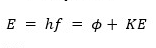
Where:
- E = photon energy
- h = Planck’s constant
- f = frequency of light
- ϕ = work function
- KE = kinetic energy of ejected electron
Experiment: Shine UV light on a metal plate; observe ejection of electrons (simulated or via video).
- Principle of LASER:
- LASER = Light Amplification by Stimulated Emission of Radiation
- Produces coherent, monochromatic, high-intensity light
- Applications: eye surgery, bar code scanners, communication, military range finding
Learners’ Activities:
- Arrange electromagnetic waves in order of frequency.
- Identify devices that use each type of wave.
- Watch a simulation of the photoelectric effect.
- Explore how lasers are used in real life.
Consolidation (Review and Assessment) – 10 minutes
Oral Questions:
- Name three regions of the electromagnetic spectrum.
- What is the speed of all electromagnetic waves in a vacuum?
- What happens in the photoelectric effect?
Assignment:
- Draw and label the electromagnetic spectrum.
- List five applications of lasers and identify the type of wave used in a microwave oven.
Notes – Detailed and Explained
- The electromagnetic spectrum includes both visible and invisible waves.
- Each region has specific applications due to its wavelength/frequency.
- Photoelectric effect proves that light behaves like a particle (quantum theory).
- Laser beams are focused, powerful, and used widely in science and technology.
Expanded Notes / Instructions:
- Emphasize safety around UV and X-rays.
- Encourage exploration of wave properties using simulations or science apps.
- Use real-world items (remote control, microwave) to connect theory to practice.
Differentiation:
- Diagrams and spectrum charts for visual learners.
- Simulations and video demonstrations for audio-visual learners.
- Worksheet sorting electromagnetic waves by frequency, wavelength, and use.
Teacher’s Reflection:
- Did learners grasp the concept of wave regions and their uses?
- Were they able to relate real-world devices to electromagnetic waves?
- Was the photoelectric effect understood through simulation?