Download the Lessonotes Mobile Liberia app for faster lesson access on Android and iPhone.


Subject: Physics
Semester: 1
Period: 2
Week: 11
School Name:
Teacher’s Name:
Subject: Physics
Grade Level: Grade 11
Week & Period: Week 11, Period II
Date:
Sub-topic: Friction
Learning Objectives
By the end of the lesson, learners will be able to:
- Define friction and its causes.
- Distinguish between static, sliding, and rolling friction.
- Calculate the coefficient of friction.
- Describe factors affecting friction.
Previous Knowledge
Forces and motion basics.
Instructional Materials
- Wooden plank
- Weights
- Spring balance
- Rough and smooth surfaces
- Stopwatch
Anticipation (Warm-Up) – 5 minutes
Ask:
- “Why do some objects slide easily while others don’t?”
- “Can friction ever be helpful?”
Building Knowledge (Main Lesson) – 25 minutes
- Friction:
- Force opposing relative motion between surfaces in contact.
- Caused by surface roughness and molecular forces.
- Types of Friction:
- Static friction: Prevents start of motion.
- Sliding friction: Opposes motion during sliding.
- Rolling friction: Opposes motion during rolling; generally smaller.
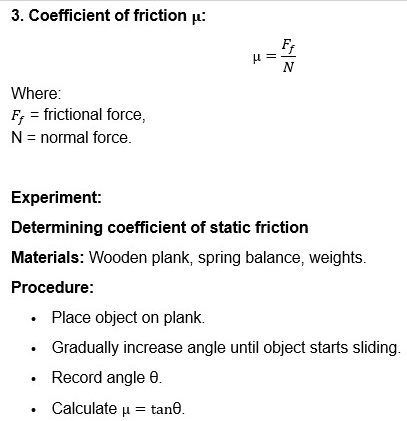
Example Calculation:
An object starts sliding down a 30° inclined plane. Find coefficient of static friction.
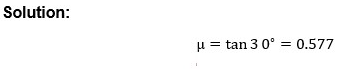
Learners’ Activities
- Measure frictional forces on different surfaces.
- Compare static and sliding friction.
Consolidation (Review and Assessment) – 10 minutes
Oral Questions:
- What causes friction?
- Differentiate static and sliding friction.
- Calculate coefficient of friction given forces.
Homework / Assignment
- Find frictional force acting on a box of 10 kg pulled with 30 N force.
- Describe three ways to reduce friction.
Notes – Detailed and Explained
- Friction is essential in walking, driving.
- Excessive friction causes wear and energy loss.
- Coefficient of friction depends on surface types.
Expanded Notes / Instructions
- Use diagrams to explain friction forces.
- Include real-life examples of friction use and control.
Inclusive / Differentiation
- Practical demonstrations for all learners.
- Stepwise problem-solving sessions.
Teacher’s Reflection
- Was friction clearly understood?
- Did experiment demonstrate friction effects?