Download the Lessonotes Mobile Liberia app for faster lesson access on Android and iPhone.


Subject: Physics
Semester: 2
Period: 4
Week: 23
School Name:
Teacher’s Name:
Subject: Physics
Grade Level: Grade 11
Week & Period: Week 23, Period IV
Date:
Sub-topic: Heat Transfer and Laws of Heat Exchange
Learning Objectives:
By the end of this lesson, learners should be able to:
- Describe the three modes of heat transfer: conduction, convection, and radiation.
- Explain how heat travels through solids, liquids, and gases.
- State and apply the Laws of Heat Exchange.
- Identify good and poor conductors, and practical applications of each.
- Demonstrate the principles of thermal insulation and heat transfer in daily life.
Previous Knowledge:
Students are already familiar with the concept of heat and energy changes during state transitions. They've also covered specific and latent heat in previous weeks.
Instructional Materials:
- Metal rods (copper, iron, etc.)
- Candle and tripod stand
- Thumb tacks
- Heated water beaker
- Potassium permanganate crystals
- Black and shiny cans
- Heat source (lamp or sun)
- Infrared thermometer (if available)
Anticipation (Warm-Up) – 5 minutes:
Ask:
- "Why does metal feel colder than wood at the same room temperature?"
- "Why do we wear white clothes in hot weather?"
Use these questions to introduce the different methods of heat transfer.
Building Knowledge (Main Lesson) – 25 minutes:
- Conduction:
- Transfer of heat through solids without movement of the material.
- Particles vibrate and transfer energy to neighboring particles.
- Good conductors: metals (copper, aluminum).
- Poor conductors: wood, plastic, rubber.
Experiment:
Compare heat conduction in copper and iron rods
- Fix thumbtacks with wax on each rod
- Heat one end
- Observe which tacks fall first → better conductor
- Convection:
- Transfer of heat through liquids and gases via movement of particles.
- Heated particles become less dense and rise, cooler particles sink.
Experiment:
Use a beaker with water and potassium permanganate
- Heat one side gently
- Observe upward movement of purple streamlines → convection current
- Radiation:
- Transfer of heat via electromagnetic waves.
- Does not require a medium (can occur in vacuum).
Demonstration:
- Place water in a black can and shiny can in the sun.
- Use thermometer to track temperature rise.
- Black can absorbs more → better absorber.
- Laws of Heat Exchange:
Zeroth Law of Thermodynamics:
If two bodies are in thermal equilibrium with a third, they are in equilibrium with each other.
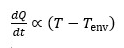
Newton’s Law of Cooling:
Rate of heat loss of a body is proportional to the temperature difference between the body and its surroundings.
Learners’ Activities:
- Group work: Classify daily objects as conductors or insulators.
- Record temperature changes in radiation and convection experiments.
- Build a model of a thermos flask to explore insulation.
Consolidation (Review and Assessment) – 10 minutes:
Oral Questions:
- Why is convection not possible in solids?
- Which mode of heat transfer works in a vacuum?
- What surfaces absorb radiant heat more efficiently?
Homework / Assignment:
- List 3 good conductors and 3 poor conductors.
- Describe an application of convection in the kitchen.
- Explain why houses in hot climates are painted white.
Expanded Notes / Instructions:
- Radiation is key in solar heating and satellite temperature control.
- Conduction explains why metal pots heat quickly.
- Convection is essential in ocean currents, weather systems, and boiling.
- Good insulators help in reducing energy waste (e.g., refrigerators, vacuum flasks).
Differentiation:
- Use vivid real-life examples (pots, thermos, fans).
- Demonstrate with simple tools—let learners touch and observe differences.
- Provide challenge tasks: design a thermal insulation model from recycled materials.
Teacher’s Reflection:
- Did learners clearly distinguish among conduction, convection, and radiation?
- Were experimental demonstrations engaging and conclusive?
- Were the laws of heat exchange understood in relation to real-life events?