Download the Lessonotes Mobile Liberia app for faster lesson access on Android and iPhone.


Subject: Physics
Semester: 2
Period: 4
Week: 21
School Name:
Teacher’s Name:
Subject: Physics
Grade Level: Grade 11
Week & Period: Week 21, Period IV
Date:
Sub-topic: Heat Transfer and the Laws of Heat Exchange
Learning Objectives:
By the end of the lesson, learners should be able to:
- Identify and explain the three methods of heat transfer: conduction, convection, and radiation.
- State and apply the laws governing heat exchange.
- Demonstrate practical experiments to illustrate conduction, convection, and radiation.
- Analyze how insulation and material type affect heat transfer.
- Describe heat transfer in daily life and scientific contexts (e.g., vacuum flask, greenhouses).
Previous Knowledge:
Learners are familiar with heat as a form of energy, and the concept of temperature and specific heat.
Instructional Materials:
- Metal rods with wax and thumbtacks
- Candle
- Convection box or large transparent container
- Water, potassium permanganate or food coloring
- Radiant heater or infrared lamp
- Foil, dark and shiny cans
- Thermometers
- Vacuum flask (for demonstration)
Anticipation (Warm-Up) – 5 minutes:
Ask:
- “How does a spoon get hot when left in a hot soup?”
- “Why does warm air rise in a room?”
- “Why are cooking pots shiny inside and black at the bottom?”
Let learners suggest what they think happens in each case—introduce the day’s focus on heat transfer mechanisms.
Building Knowledge (Main Lesson) – 25 minutes:
- Conduction:
- Heat transfer through a material without movement of the particles themselves.
- Occurs mostly in solids (e.g., metals).
- Experiment: Fix thumbtacks with wax along a metal rod. Heat one end with a candle. Observe which tack falls first.
Key Point:
Metals are good conductors because they contain free electrons that quickly transfer energy.
- Convection:
- Transfer of heat by movement of fluid (liquid or gas).
- Experiment: Heat water in a glass container. Add a few crystals of potassium permanganate. Watch colored currents rise and fall.
- Used in geysers, sea breezes, ventilation.
- Radiation:
- Heat transfer without any medium; through electromagnetic waves.
- Occurs in space.
- Demonstration: Place two cans (black and silver) under a lamp. Measure temperature rise using thermometers.
- Black surfaces absorb and emit better than shiny surfaces.
- Laws of Heat Exchange:
- Heat always flows from hotter to cooler body until thermal equilibrium is reached.
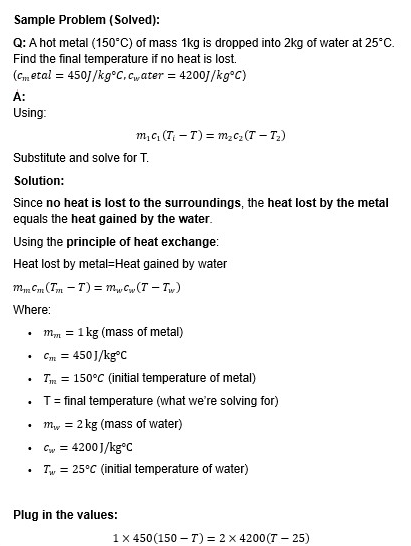
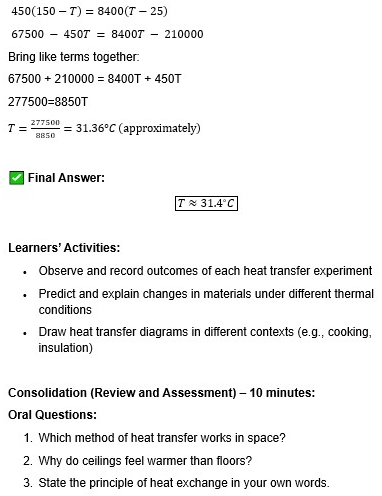
- The Principle of Heat Exchange:
If no heat is lost to surroundings:
Heat lost by hot body=Heat gained by cold body
Experiment: Investigating Convection in Water
Materials:
Beaker, tripod, Bunsen burner, potassium permanganate, water, spoon
Procedure:
- Fill beaker with water and place on tripod.
- Add a few crystals of potassium permanganate to one side.
- Gently heat the bottom center of the beaker.
- Observe movement of colored water.
Observation:
Color rises at the heated point and circulates, showing convection currents.
Homework / Assignment:
- Explain three ways heat can be transferred and give one example of each.
- Discuss how a vacuum flask minimizes heat transfer.
- A metal block loses 5000J of heat, raising 1kg of water. What’s the rise in water temperature? (c = 4200 J/kg°C)
Expanded Notes / Instructions:
- Conduction requires contact; convection requires fluid; radiation works in vacuum.
- The thermos flask uses silver lining, vacuum, and tight seals to reduce all forms of heat transfer.
- In everyday appliances (air conditioners, kettles, radiators), multiple transfer modes often work together.
Inclusive / Differentiation:
- Visual aids (diagrams, animations)
- Kinesthetic learners use materials to build convection and radiation setups
- Higher-level students solve quantitative heat exchange problems
Teacher’s Reflection:
- Did students clearly identify and distinguish the 3 transfer methods?
- Were group activities engaging and scientifically accurate?
- Did learners apply the principle of heat exchange correctly?