Download the Lessonotes Mobile Liberia app for faster lesson access on Android and iPhone.


Subject: Physics
Semester: 2
Period: 5
Week: 28
School Name:
Teacher’s Name:
Subject: Physics
Grade Level: Grade 11
Week & Period: Week 28, Period V
Date:
Sub-topic: Intensity of Sound, Intensity Level, and the Doppler Effect
Learning Objectives:
By the end of the lesson, learners should be able to:
- Define sound intensity and intensity level.
- Explain the relationship between loudness, intensity, and decibel scale.
- Distinguish between intensity and loudness.
- Explain the Doppler Effect and its real-life applications.
- Solve numerical problems involving intensity and Doppler Effect.
Previous Knowledge:
Learners have been introduced to sound production, transmission, and its characteristics including pitch and loudness.
Instructional Materials:
- Sound meter or phone app with decibel reader
- Moving sound source (e.g., ringing bell on string)
- Charts of intensity levels in decibels
- Car horn or speaker (optional)
- Videos showing Doppler shift in sirens or passing vehicles
Anticipation (Warm-Up) – 5 minutes:
Ask:
- "Why does a car horn sound different as it moves past you?"
- "What happens to the loudness of music as you walk away from a speaker?"
Play a sound clip of a car passing by and ask learners to describe the change in sound.
|
Intensity Level (dB) |
Example |
|
10–30 |
Whisper |
|
60 |
Normal conversation |
|
90+ |
Loud machinery |
|
120 |
Pain threshold |
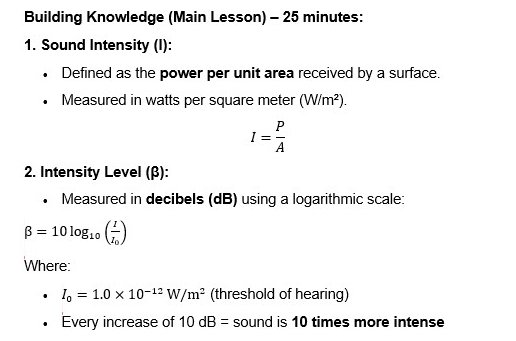
- Loudness vs Intensity:
- Intensity is objective (measurable); loudness is subjective (depends on human hearing).
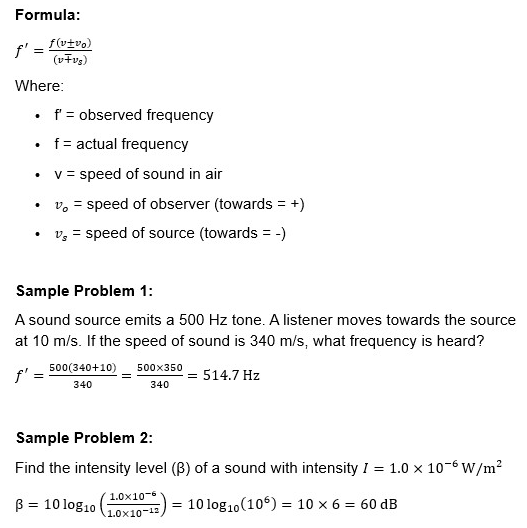
- Doppler Effect:
- Change in frequency due to relative motion between source and observer.
- Approaching source → higher frequency (pitch)
- Receding source → lower frequency (pitch)
Learners’ Activities:
- Use decibel app to measure sound levels in different classroom areas.
- Roleplay observer and moving sound source to simulate Doppler effect.
- Solve intensity and Doppler-related calculations.
Experiment:
Title: Demonstrating the Doppler Effect
Materials: Toy car or cart, bell or buzzer, stopwatch, microphone or phone recorder
Procedure:
- Attach buzzer to moving cart.
- Roll cart toward and away from listener.
- Record sound and compare frequency/pitch.
Observation: Pitch is higher when source approaches, lower when it moves away.
Homework / Assignment:
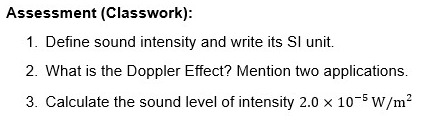
- Explain how the Doppler Effect helps in measuring speed of cars.
- Find the observed frequency if a 400 Hz source approaches a stationary listener at 20 m/s.
- List 3 devices that measure or apply sound intensity.
Expanded Notes:
- Doppler Effect used in police radars, ultrasound scans, astronomy
- Ear perceives sound logarithmically – hence decibels
- High exposure to sound above 85 dB can damage hearing
Differentiation:
- Videos and role-play for auditory and kinesthetic learners
- Guided calculation examples for struggling learners
- Chart and decibel meter visuals for visual learners
Teacher’s Reflection:
- Did learners correctly relate pitch and motion in Doppler Effect?
- Were logarithmic intensity concepts understood?
- Was the concept of decibels clearly communicated?