Download the Lessonotes Mobile Liberia app for faster lesson access on Android and iPhone.


Subject: Physics
Semester: 2
Period: 4
Week: 22
School Name:
Teacher’s Name:
Subject: Physics
Grade Level: Grade 11
Week & Period: Week 22, Period IV
Date:
Sub-topic: Latent Heat of Fusion and Vaporization
Learning Objectives:
By the end of this lesson, learners should be able to:
- Define latent heat, latent heat of fusion, and latent heat of vaporization.
- Explain the differences between specific latent heat of fusion and vaporization.
- Solve numerical problems involving latent heat.
- Describe experiments to determine latent heat.
- Analyze the process of melting, boiling, and energy exchange without temperature change.
Previous Knowledge:
Students already understand the concepts of heat, temperature, and specific heat capacity.
Instructional Materials:
- Ice cubes
- Calorimeter
- Thermometer
- Electrical immersion heater
- Water and beaker
- Stopwatch
- Spring balance
- Boiling tube
- Heat source
- Tripod stand, wire gauze
- Graph paper (optional for temperature-time plots)
Anticipation (Warm-Up) – 5 minutes:
Ask:
- "Why does temperature stay constant while ice is melting or water is boiling?"
- "Why does it take longer to boil water than to heat it up?"
Use these to introduce the concept of latent heat.
Building Knowledge (Main Lesson) – 25 minutes:
- Definition of Latent Heat:
Latent heat is the amount of heat energy required to change the state of a substance without changing its temperature.
- Latent Heat of Fusion: Heat needed to change 1 kg of a solid to liquid at its melting point.
- Latent Heat of Vaporization: Heat needed to change 1 kg of a liquid to gas at boiling point.
Unit: Joules per kilogram (J/kg)
- Explanation and Diagrams:
- When a solid melts or a liquid boils, its temperature remains constant even though heat is still being added.
- The energy is used to break intermolecular bonds instead of raising temperature.
Graph:
Temperature vs. time graph showing plateau during melting and boiling.
- Equation for Latent Heat Calculations:
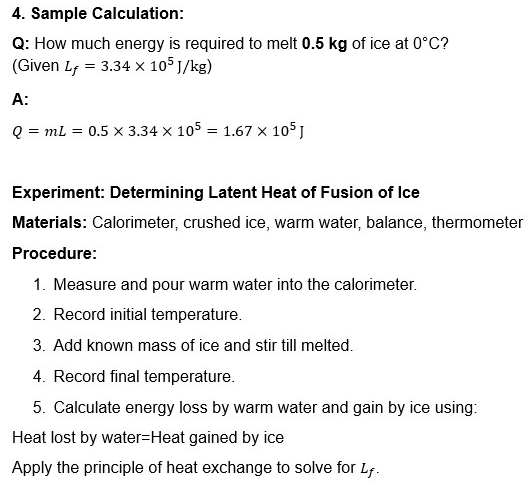
Q=mL
Where:
- Q = heat energy (J)
- m = mass of the substance (kg)
- L = specific latent heat (J/kg)
Learners’ Activities:
- Work in groups to calculate heat energy for phase changes using different values.
- Draw temperature-time graphs of heating ice to steam.
- Perform the ice-melting calorimetry experiment in class.
Consolidation (Review and Assessment) – 10 minutes:
Oral Questions:
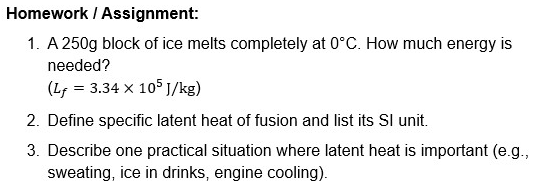
- What is latent heat of vaporization?
- Why does temperature not change during a phase change?
- How would you experimentally determine the latent heat of fusion?
Expanded Notes / Instructions:
- Latent heat is crucial in weather systems, energy storage, cooling systems, and metallurgy.
- Phase changes involve internal energy shifts, not temperature rise.
- Water’s high latent heat makes it useful in stabilizing temperatures (e.g., climate, body cooling).
Inclusive / Differentiation:
- Use animations or simulations for phase change visualization.
- Assist weaker learners with step-by-step breakdown of heat exchange problems.
- Challenge advanced learners with real-world application problems (e.g., how refrigerators use latent heat).
Teacher’s Reflection:
- Did learners understand the distinction between specific and latent heat?
- Were calculations correctly applied?
- Did experiments reinforce theoretical understanding?