Download the Lessonotes Mobile Liberia app for faster lesson access on Android and iPhone.


Subject: Physics
Semester: 1
Period: 2
Week: 9
School Name:
Teacher’s Name:
Subject: Physics
Grade Level: Grade 11
Week & Period: Week 9, Period II
Date:
Sub-topic: Parallel Forces and Moments (Torque)
Learning Objectives
By the end of this lesson, learners should be able to:
- Understand and calculate resultant of parallel forces.
- Define and calculate moments (torques) about a pivot.
- Understand and apply the principle of moments in equilibrium.
- Identify practical applications of moments.
Previous Knowledge
Basic force addition and equilibrium.
Instructional Materials
- Meter sticks or rigid rods
- Weights of different masses
- Supports or pivots
- Spring balances
Anticipation (Warm-Up) – 5 minutes
Ask:
- “How do seesaws balance?”
- “What does it mean to ‘turn’ an object around a point?”
Building Knowledge (Main Lesson) – 25 minutes
- Parallel Forces:
- Forces acting in the same or opposite directions along parallel lines.
- Resultant magnitude is the algebraic sum.
- Resultant line of action found by taking moments.
- Moments (Torque):
- Moment = Force × Perpendicular distance from pivot.
- Unit: Newton-meter (Nm)
- Principle of Moments:
- For equilibrium, sum of clockwise moments = sum of anticlockwise moments.
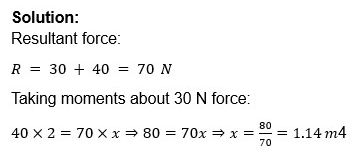
Example Calculation:
Two forces 30 N and 40 N act parallel on a beam 2 m apart. Calculate resultant force and position from the 30 N force.
Learners’ Activities
- Use a meter stick on a pivot and hang weights.
- Calculate moments and resultant forces.
- Verify the principle of moments experimentally.
Consolidation (Review and Assessment) – 10 minutes
Oral Questions:
- Define moment of force.
- Calculate moment of 50 N force acting 0.5 m from pivot.
- Explain how seesaws balance using moments.
Homework / Assignment
- Two weights of 25 N and 35 N act 1.5 m apart. Find resultant force and its position relative to 25 N force.
- Explain with example the principle of moments.
Notes – Detailed and Explained
- Moments cause rotation about a point.
- Principle of moments is fundamental in mechanics and engineering.
- Practical applications include levers, seesaws, and bridges.
Expanded Notes / Instructions
- Use diagrams extensively.
- Reinforce with hands-on experiments.
Inclusive / Differentiation
- Group practicals for social learners.
- Visual aids and stepwise calculation guidance.
Teacher’s Reflection
- Was the moment concept clearly understood?
- Did practical demonstration improve grasp?