Download the Lessonotes Mobile Liberia app for faster lesson access on Android and iPhone.


Subject: Physics
Semester: 1
Period: 1
Week: 3
School Name:
Teacher’s Name:
Subject: Physics
Grade Level: Grade 11
Week & Period: Week 3, Period I
Date:
Sub-topic: Projectile Motion
Learning Objectives
By the end of this lesson, learners should be able to:
- Define projectile motion and identify its characteristics.
- Understand the independence of horizontal and vertical motions.
- Use equations of motion to analyze projectile trajectories.
- Calculate range, time of flight, and maximum height of projectiles.
Previous Knowledge
Learners should know about vectors, resolution of vectors, and equations of uniform motion.
Instructional Materials
- Projectile launcher (or improvised setup using a spring or ramp)
- Stopwatch
- Meter rule
- Graph paper
- Whiteboard and markers
Anticipation (Warm-Up) – 5 minutes
Ask:
- “What path does a ball follow when thrown at an angle?”
- “Can the horizontal and vertical parts of this motion be considered separately?”
Lead into projectile motion as two-dimensional motion under gravity.
Building Knowledge (Main Lesson) – 25 minutes
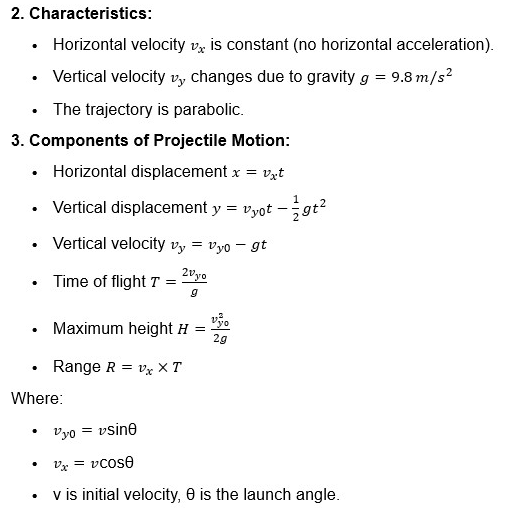
- Definition:
- A projectile is an object thrown into the air, moving under the influence of gravity alone (neglecting air resistance).
Example Calculation:
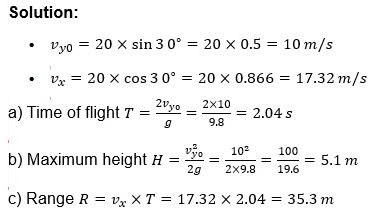
A projectile is launched with an initial velocity of 20 m/s at an angle of 30° to the horizontal. Calculate:
a) Time of flight
b) Maximum height
c) Range
Learners’ Activities
- Conduct a simple experiment by rolling a ball off a table to observe projectile motion.
- Calculate time of flight and range for different launch angles and speeds.
- Plot the trajectory on graph paper using calculated points.
Consolidation (Review and Assessment) – 10 minutes
Oral Questions:
- What forces act on a projectile during its flight?
- Why does the horizontal velocity remain constant?
- Calculate the range for a projectile launched at 25 m/s at 45°.
Homework / Assignment
- A projectile is launched at 15 m/s at 60°. Calculate: time of flight, maximum height, and range.
- Draw the path of a projectile and label key points (maximum height, range, time of flight).
Notes – Detailed and Explained
- Projectile motion is two-dimensional motion composed of independent horizontal and vertical motions.
- Gravity only affects vertical motion, causing acceleration downward.
- Understanding projectile motion is crucial for sports, engineering, and ballistics.
- Calculations rely heavily on trigonometry and equations of motion.
Expanded Notes / Instructions
- Emphasize the independence of horizontal and vertical components.
- Use diagrams to illustrate vector components and trajectory.
- Discuss assumptions (e.g., neglecting air resistance).
Inclusive / Differentiation
- Use videos or animations to visualize projectile motion for visual learners.
- Hands-on experiments for kinesthetic learners.
- Provide stepwise problem-solving guides for learners needing extra support.
Teacher’s Reflection (Post-Lesson Questions)
- Did learners understand the parabolic nature of projectile motion?
- Were they able to separate motions into components effectively?
- How well did they apply formulas to calculate flight time, height, and range?