Download the Lessonotes Mobile Liberia app for faster lesson access on Android and iPhone.


Subject: Physics
Semester: 2
Period: 6
Week: 32
School Name:
Teacher’s Name:
Subject: Physics
Grade Level: Grade 11
Week & Period: Week 32, Period VI
Date:
Topic: Properties and Propagation of Light
Sub-topic: Rectilinear Propagation, Shadows and Eclipses
Learning Objectives:
By the end of the lesson, learners should be able to:
- Explain the rectilinear propagation of light.
- Identify types of materials based on how they transmit light (transparent, translucent, opaque).
- Describe how shadows are formed.
- Illustrate the causes of solar and lunar eclipses using diagrams.
- Discuss applications of rectilinear propagation in devices like the pin-hole camera.
Previous Knowledge:
Learners already understand that light travels and that it can be blocked by materials to form shadows.
Instructional Materials:
- Cardboard with a pin-hole
- White screen
- Torchlight or candle
- Balls of different sizes
- Diagrams of sun, earth, and moon
- Transparent (glass), translucent (frosted plastic), and opaque (wood) materials
Anticipation (Warm-Up) – 5 minutes:
Ask learners:
- “Why do shadows form?”
- “Why does the moon sometimes become dark during the full moon?”
Display a light source and an object to project a shadow on a wall, and let students observe.
Building Knowledge (Main Lesson) – 25 minutes
- Rectilinear Propagation of Light:
- Light travels in straight lines in a uniform medium.
- Demonstrated by shining a light through aligned holes in cardboards — light only passes through when all holes are in a straight line.
- Types of Materials:
- Transparent: Allow light to pass through clearly (glass).
- Translucent: Allow partial light (frosted glass).
- Opaque: Block light (wood, stone).
- Formation of Shadows:
- Umbra: Full shadow (darkest region).
- Penumbra: Partial shadow (lighter region).
- Shape and size depend on the position and size of the object and light source.
- Eclipses:
- Solar Eclipse: Moon comes between sun and earth.
- Lunar Eclipse: Earth comes between sun and moon.
Diagram Activity: Learners draw diagrams of both solar and lunar eclipses.
- Pin-Hole Camera:
- Based on rectilinear propagation.
- Produces inverted images on a screen using a tiny hole and a dark box.
Learners’ Activities:
- Observe shadow formation using a light and object.
- Classify materials as transparent, translucent, or opaque.
- Create and test a simple pin-hole camera with a cardboard box.
- Role-play sun-earth-moon system using balls and light source.
Experiment: Constructing a Pin-Hole Camera
Title: Making and Using a Pin-hole Camera
Materials:
- Cardboard box
- Aluminum foil
- White paper
- Needle
- Tape
Procedure:
- Cut one end of the box and cover it with white paper (screen).
- Cover the opposite end with aluminum foil and poke a small hole in the center.
- Seal the box and leave a viewing window.
- Point the hole at a bright object.
Observation: An inverted image appears on the white screen.
Sample Calculation:
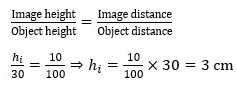
Q: If the distance from the object to the pin-hole is 100 cm and the distance from the pin-hole to the screen is 10 cm, and the object is 30 cm tall, what is the height of the image?
Using the formula:
Consolidation (Review and Assessment) – 10 minutes
Oral Questions:
- What is rectilinear propagation?
- What is the difference between umbra and penumbra?
- What happens during a solar eclipse?
Assignment:
- Explain why the image formed by a pin-hole camera is inverted.
- Describe the conditions necessary for a lunar eclipse to occur.
- Draw a labeled diagram of a pin-hole camera.
Notes – Detailed and Explained
- Light always travels in straight lines in a uniform medium unless reflected or refracted.
- Shadows form because light cannot pass through opaque objects.
- Eclipses occur due to alignment of sun, earth, and moon.
- The pin-hole camera demonstrates straight-line travel of light and image formation.
Expanded Notes / Instructions
- Encourage learners to explore other light-based devices (e.g., magnifying glass, microscope).
- Use a large globe and tennis ball to model eclipses.
- Stress safety when observing solar eclipses — never look directly at the sun.
Inclusive / Differentiation:
- Shadow-prediction games for kinesthetic learners.
- Diagram-based eclipse illustrations for visual learners.
- Group modeling of eclipse events for collaborative learning.
Teacher’s Reflection:
- Were learners able to clearly distinguish between types of materials?
- Did the pin-hole camera activity work successfully?
- Were diagrams of solar/lunar eclipses accurate?