Download the Lessonotes Mobile Liberia app for faster lesson access on Android and iPhone.


Subject: Physics
Semester: 2
Period: 6
Week: 35
School Name:
Teacher’s Name:
Subject: Physics
Grade Level: Grade 11
Week & Period: Week 35, Period VI
Date:
Topic: Reflection of Light by Plane and Spherical Mirrors
Sub-topic: Laws of Reflection, Image Formation in Plane and Spherical Mirrors
Learning Objectives:
By the end of the lesson, learners should be able to:
- State and explain the laws of reflection.
- Describe the nature and characteristics of images formed by plane and spherical mirrors.
- Draw ray diagrams to show image formation in concave and convex mirrors.
- Apply the mirror formula and magnification equations in solving numerical problems.
Previous Knowledge:
Students already understand that light travels in straight lines and can be reflected.
Instructional Materials:
- Plane mirror
- Concave and convex mirrors
- Light rays (pins and paper or laser pointers)
- Protractor
- Mirror stands
- Whiteboard with ray diagram samples
Anticipation (Warm-Up) – 5 minutes:
Ask:
- “Why do we see our reflection in mirrors?”
- “Can a mirror make you look taller or shorter?”
Let students examine their reflection in a flat and curved mirror and observe the differences.
Building Knowledge (Main Lesson) – 25 minutes
- Laws of Reflection:
- Law 1: The incident ray, the reflected ray, and the normal all lie in the same plane.
- Law 2: The angle of incidence iii is equal to the angle of reflection r.
i=r
- Types of Reflection:
- Regular (Specular): On smooth surfaces like mirrors.
- Diffuse: On rough surfaces like paper.
- Plane Mirrors:
- Image is virtual, upright, same size, and laterally inverted.
- Image appears to be the same distance behind the mirror as the object is in front.
- Spherical Mirrors:
- Concave Mirror (converging): Curved inward; can produce real or virtual images depending on object position.
- Convex Mirror (diverging): Curved outward; always forms virtual, diminished, and upright images.
- Mirror Formula & Magnification:
- Mirror Formula:
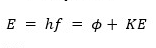
Where:
- f = focal length
- v = image distance
- u = object distance
- Magnification:
Sign Conventions (Concave is positive, Convex is negative)
- Ray Diagrams:
- For Concave Mirrors:
- Object at infinity: Real, inverted, at focus.
- Object beyond center (C): Real, inverted, between F and C.
- Object at center (C): Real, inverted, same size at C.
- Object between C and F: Real, inverted, enlarged.
- Object at focus (F): No image (rays parallel).
- Object between F and pole (P): Virtual, upright, enlarged.
- For Convex Mirrors:
- Always forms virtual, diminished, and upright images behind the mirror.
Learners’ Activities:
- Use ray boxes and mirrors to trace incident and reflected rays.
- Draw ray diagrams for various object positions.
- Calculate focal lengths and magnifications using the mirror formula.
Sample Problem:
Q: An object is placed 30 cm in front of a concave mirror of focal length 15 cm. Find the position and nature of the image.
Solution:
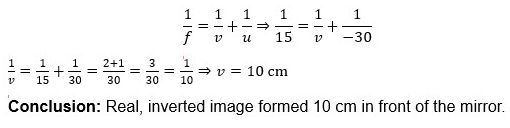
Consolidation (Review and Assessment) – 10 minutes
Oral Questions:
- What are the two laws of reflection?
- Describe the nature of images formed by convex mirrors.
- What is the mirror formula?
Homework:
- Draw ray diagrams for object:
- (a) at the center of a concave mirror
- (b) between focus and pole
- State two uses of convex mirrors in everyday life.
Notes – Detailed and Explained:
- Plane mirrors reflect light symmetrically, preserving the shape and size of images.
- Concave mirrors can enlarge images and are used in shaving mirrors and solar cookers.
- Convex mirrors give a wide field of view and are used in vehicle side mirrors.
- The mirror equation helps locate image positions for precise applications.
Expanded Notes / Instructions:
- Encourage practice with ray diagrams and solving using sign conventions.
- Allow learners to explore the effect of distance on image formation.
- Explain that real images can be projected on a screen; virtual images cannot.
Differentiation:
- Ray diagrams for visual learners.
- Practical demonstrations for kinesthetic learners.
- Formula recitations and oral quizzes for auditory learners.
Teacher’s Reflection:
- Did learners understand the concept of real and virtual images?
- Were learners able to apply the mirror formula correctly?
- How did students respond to practical and diagrammatic activities?