Download the Lessonotes Mobile Liberia app for faster lesson access on Android and iPhone.


Subject: Physics
Semester: 1
Period: 3
Week: 17
School Name:
Teacher’s Name:
Subject: Physics
Grade Level: Grade 11
Week & Period: Week 17, Period III
Date:
Sub-topic: Review of Momentum, Impulse, Collisions & Angular Momentum
Learning Objectives:
By the end of this lesson, learners should be able to:
- Revisit and reinforce key concepts on momentum and impulse.
- Differentiate clearly between elastic and inelastic collisions.
- Solve composite problems involving both linear and angular momentum.
- Apply momentum concepts to real-life and examination scenarios.
Previous Knowledge:
Students have covered momentum, impulse, conservation laws, and angular momentum in Weeks 13–16.
Instructional Materials:
- Cardboard car models
- Trolleys with spring bumpers
- Masses and pulleys
- Video clips of car crashes, rocket propulsion, skaters spinning
- Graph paper, protractors
Anticipation (Warm-Up):
Present two collision clips—one where objects bounce off each other and one where they stick together.
Ask:
- "Which collision is elastic and which is inelastic?"
- "Was momentum conserved in both?"
Building Knowledge (Main Lesson) – 25 minutes

Explains how airbags, seatbelts, and padded gloves work by increasing time of impact to reduce force.
- Types of Collisions Recap:
|
Feature |
Elastic Collision |
Inelastic Collision |
|
Kinetic Energy |
Conserved |
Not Conserved |
|
Momentum |
Conserved |
Conserved |
|
Example |
Bouncing balls |
Car crash, bullet in block |
- Combined Problem (Linear + Angular Momentum):
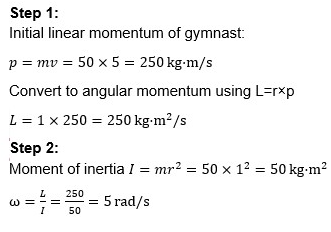
A gymnast of mass 50 kg running at 5 m/s jumps onto a stationary 10 kg rotating platform of radius 1 m. The gymnast lands at the edge. Calculate the angular velocity of the system after landing.
Experiment:
Title: Measuring Impulse and Momentum Change Using Collision Carts
Materials:
- 2 carts (1 spring-loaded)
- Stopwatch
- Ruler
- Masses
Procedure:
- Load cart with mass and compress spring.
- Measure velocity before and after collision with another cart.
- Use data to calculate momentum and impulse.
Learners’ Activities:
- Complete a worksheet comparing elastic vs inelastic collisions.
- Solve 3 past exam problems mixing impulse, collisions, and angular momentum.
- Sketch diagrams of momentum conservation in sports (e.g., diving, basketball rebound).
Consolidation (Review and Assessment) – 10 minutes
Oral Questions:
- What is the main difference between impulse and momentum?
- Why do astronauts push off slowly in space?
- In which type of collision is kinetic energy conserved?
Homework / Assignment:
- A 1.5 kg object moving at 3 m/s collides with a stationary 2 kg object. After collision, the 1.5 kg object moves at 1 m/s. Find the velocity of the second object.
- A spinning dancer has an angular momentum of 12 kg·m²/s. If her moment of inertia is 3 kg·m², what is her angular velocity?
Notes – Detailed and Explained:
- Impulse is the change in momentum caused by a force over time.
- Elastic collisions conserve both momentum and kinetic energy; inelastic collisions conserve momentum only.
- Angular momentum behaves similarly to linear momentum but is influenced by rotational mass (moment of inertia).
- These principles are widely used in:
- Car safety (airbags, crumple zones)
- Sports (boxing, diving, skating)
- Space exploration (rockets, satellites)
Expanded Notes / Instructions:
- Reinforce graphical analysis of momentum vs time.
- Guide students to plot velocity-time graphs of collisions.
- Use simulations if physical experiments aren't available.
Differentiation:
- Use role-play for collisions
- Provide formula sheets for those who struggle
- Encourage peer tutoring during problem-solving activities
Teacher’s Reflection:
- Were students able to transition from linear to angular momentum comfortably?
- Did they apply real-life understanding to theoretical questions?
- Should I add more visual representations in future reviews?