Download the Lessonotes Mobile Liberia app for faster lesson access on Android and iPhone.


Subject: Physics
Semester: 1
Period: 1
Week: 5
School Name:
Teacher’s Name:
Subject: Physics
Grade Level: Grade 11
Week & Period: Week 5, Period I
Date:
Sub-topic: Rotary/Rotational Motion
Learning Objectives
By the end of this lesson, learners should be able to:
- Define rotary/rotational motion and differentiate it from linear motion.
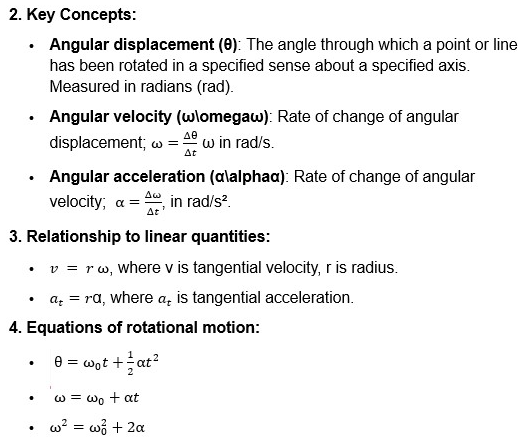
- Explain angular displacement, angular velocity, and angular acceleration.
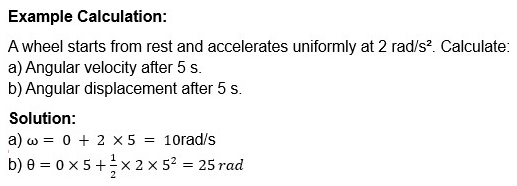
- Calculate quantities related to rotational motion.
- Identify examples and applications of rotary motion.
Previous Knowledge
Learners should understand linear motion, velocity, acceleration, and circular motion concepts.
Instructional Materials
- Rotating discs or turntables
- Stopwatch
- Meter rule
- Whiteboard and markers
Anticipation (Warm-Up) – 5 minutes
Ask:
- “What kind of motion does a spinning wheel exhibit?”
- “How is rotary motion different from straight-line motion?”
Introduce rotary motion as motion about a fixed axis.
Building Knowledge (Main Lesson) – 25 minutes
- Definition:
- Rotary or rotational motion is the motion of a body about a fixed axis or point.
Learners’ Activities
- Spin a disc and time the rotations to calculate angular velocity.
- Calculate angular displacement for different time intervals.
- Discuss real-life examples: wheels, fans, clocks.
Consolidation (Review and Assessment) – 10 minutes
Oral Questions:
- Define angular velocity and angular acceleration.
- Calculate the angular velocity of a wheel that completes 30 revolutions in 10 seconds.
- How does angular velocity relate to tangential velocity?
Homework / Assignment
- A wheel accelerates from rest at 3 rad/s² for 4 seconds. Calculate the angular displacement.
- List 5 examples of rotary motion in machines.
Notes – Detailed and Explained
- Rotary motion differs from linear motion by revolving about a fixed axis.
- Angular quantities describe rotational motion and are closely related to linear quantities.
- Understanding rotary motion helps in analyzing rotating machinery and wheels.
Expanded Notes / Instructions
- Emphasize units of angular measurement (radians).
- Demonstrate the relationship between linear and angular quantities with practical examples.
Inclusive / Differentiation
- Use rotating discs for hands-on learning.
- Visual aids for conceptual understanding.
- Step-by-step guidance in calculations.
Teacher’s Reflection (Post-Lesson Questions)
- Did learners understand the difference between linear and rotational motion?
- Were learners able to calculate angular quantities accurately?
- Did practical activities enhance understanding?