Download the Lessonotes Mobile Liberia app for faster lesson access on Android and iPhone.


Subject: Physics
Semester: 2
Period: 4
Week: 20
School Name:
Teacher’s Name:
Subject: Physics
Grade Level: Grade 11
Week & Period: Week 20, Period IV
Date:
Sub-topic: Specific Heat and Heat Capacity
Learning Objectives:
By the end of the lesson, learners should be able to:
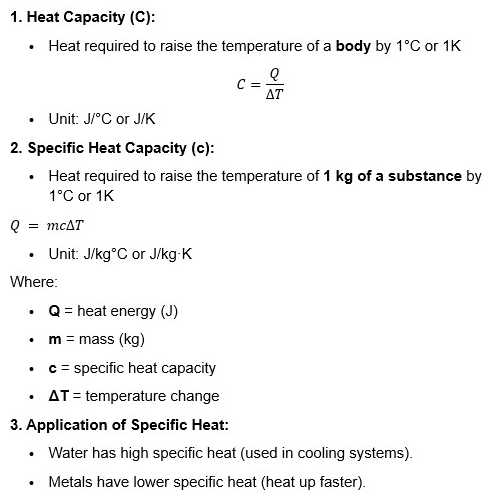
- Define specific heat capacity and heat capacity.
- Identify the SI units of both quantities.
- Solve problems involving heat capacity and specific heat capacity.
- Conduct and explain simple experiments to determine specific heat capacity.
- Distinguish between high and low specific heat capacities in everyday materials.
Previous Knowledge:
Learners have been introduced to the concept of heat, its unit (Joule), and its transfer.
Instructional Materials:
- Calorimeter
- Thermometer
- Water
- Weighing balance
- Electrical heater or immersion coil
- Stopwatch
- Digital voltmeter and ammeter
- Known metal samples (copper, iron, aluminum)
- Stirring rod
- Heatproof gloves
Anticipation (Warm-Up) – 5 minutes:
Ask:
- “Why does water take longer to heat up than metal?”
- “Which material gets hotter faster when heated under the same condition?”
Building Knowledge (Main Lesson) – 25 minutes:
Experiment: Determining the Specific Heat Capacity of a Metal
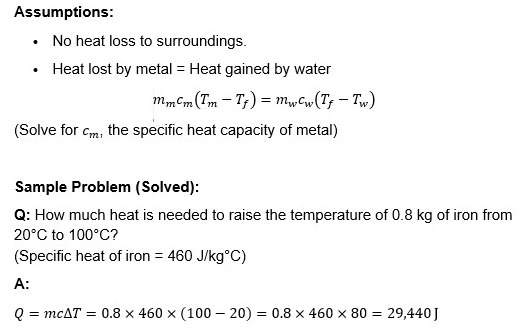
Title: Finding the specific heat capacity of aluminum using the method of mixtures.
Materials:
- Calorimeter
- Hot aluminum block (preheated)
- Cold water (measured)
- Thermometer
- Balance scale
- String or tongs
Procedure:
- Measure and record the mass of the cold water.
- Record its initial temperature.
- Heat aluminum block to a known high temperature.
- Transfer hot metal into cold water inside the calorimeter.
- Stir gently and record final equilibrium temperature.
Learners’ Activities:
- Carry out specific heat experiment using method of mixtures.
- Record values and compute results.
- Compare the thermal response of water vs. metal to heat input.
- Solve structured word problems in groups.
Consolidation (Review and Assessment) – 10 minutes:
Oral Questions:
- What does specific heat capacity depend on?
- Why is water used for cooling engines?
- Calculate the heat needed to raise 2kg of water from 30°C to 80°C.
Homework / Assignment:
- Define specific heat capacity and write its formula.
- A 1.5kg copper block is heated from 25°C to 75°C. Calculate the heat supplied. (c = 390 J/kg°C)
- Discuss how specific heat is used in cooking pots and car engines.
Expanded Notes / Instructions:
- Use real-life comparisons like aluminum foil vs. water.
- Clarify confusion between heat capacity (object-based) vs. specific heat (material-based).
- Encourage accuracy in thermometer reading and timekeeping.
Inclusive / Differentiation:
- Hands-on learners: conduct the calorimetry experiment
- Struggling learners: use visual aids showing the Q = mcΔT triangle
- Advanced learners: attempt electrical method to determine c (Q = IVt)
Teacher’s Reflection:
- Did learners understand the concept and units?
- Were they able to apply the formula correctly?
- Was the experiment executed with minimal error?