Download the Lessonotes Mobile Liberia app for faster lesson access on Android and iPhone.


Subject: Physics
Semester: 1
Period: 1
Week: 1
School Name:
Teacher’s Name:
Subject: Physics
Grade Level: Grade 11
Week & Period: Week 1, Period I
Date:
Sub-topic: Vectors – Addition/Composition of Vectors
Learning Objectives
By the end of this lesson, learners should be able to:
- Define vectors and scalars.
- Understand vector addition (graphical and analytical methods).
- Perform vector addition using the head-to-tail method.
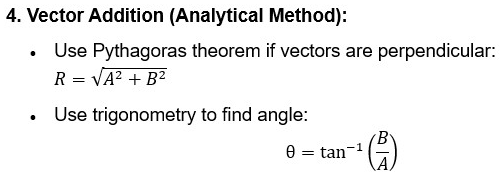
- Calculate resultant vectors using Pythagoras theorem and trigonometry.
Previous Knowledge
Learners should be familiar with basic quantities such as distance and displacement and understand difference between scalars and vectors.
Instructional Materials
- Graph paper
- Protractors
- Rulers
- Whiteboard and markers
- String and weights (optional for demonstration)
Anticipation (Warm-Up) – 5 minutes
Ask:
- “What is the difference between distance and displacement?”
- “Can you think of a quantity that has both size and direction?”
Use their answers to introduce vectors.
Building Knowledge (Main Lesson) – 25 minutes
- Definitions:
- Scalar: Quantity with magnitude only (e.g., speed, mass, time).
- Vector: Quantity with both magnitude and direction (e.g., displacement, velocity, force).
- Vector Representation:
- Arrows represent vectors; length = magnitude, arrowhead = direction.
- Vector Addition (Graphical Method):
- Head-to-tail method: Place tail of second vector at head of first vector.
- Resultant vector drawn from tail of first to head of second.
- Example: Add 3 units East and 4 units North vectors.
Learners’ Activities
- Draw two vectors on graph paper: 5 cm at 0°, 4 cm at 90°; add them graphically and find resultant.
- Calculate magnitude and direction analytically.
- Group activity: Using string and weights, physically add forces acting at right angles.
Consolidation (Review and Assessment) – 10 minutes
Oral Questions:
- What is a vector?
- How is vector addition different from scalar addition?
- Calculate the resultant of vectors 6 m east and 8 m north.
Homework / Assignment
- Draw and add two vectors of different magnitudes and directions on graph paper.
- Solve: A swimmer swims 10 m east, then 15 m north. Find displacement magnitude and direction.
Notes – Detailed and Explained
- Vectors have both magnitude and direction; their addition is not just numerical but directional.
- Graphical addition provides a visual understanding but limited by scale accuracy.
- Analytical methods use Pythagoras and trigonometry for precise results.
- Vector addition is essential in physics to analyze forces, velocity, and displacement in two or three dimensions.
Expanded Notes / Instructions
- Reinforce concepts with practical demonstrations such as adding forces with spring balances.
- Emphasize importance of direction in vector quantities.
Inclusive / Differentiation
- Use visual aids and hands-on activities for kinesthetic learners.
- Provide step-by-step guides and formula sheets for slow learners.
- Encourage peer teaching in groups for better understanding.
Teacher’s Reflection (Post-Lesson Questions)
- Did learners grasp the concept of vectors and their addition?
- Were the graphical and analytical methods understood and applied correctly?
- Did activities engage all learners effectively?