Download the Lessonotes Mobile Liberia app for faster lesson access on Android and iPhone.


Subject: Physics
Semester: 1
Period: 1
Week: 2
School Name:
Teacher’s Name:
Subject: Physics
Grade Level: Grade 11
Week & Period: Week 2, Period I
Date:
Sub-topic: Vectors – Resolution of Vectors
Learning Objectives
By the end of this lesson, learners should be able to:
- Define vector resolution and explain its importance.
- Resolve a vector into two perpendicular components.
- Calculate the magnitudes of components using trigonometry.
- Apply vector resolution to solve problems in physics.
Previous Knowledge
Learners should be familiar with vector quantities and basic trigonometry (sine, cosine, tangent).
Instructional Materials
- Graph paper
- Protractors
- Rulers
- Whiteboard and markers
- Force diagrams (prepared charts)
Anticipation (Warm-Up) – 5 minutes
Ask:
- “If a force acts at an angle, how can we find its effect in horizontal and vertical directions?”
- “Why do we break forces into components?”
Lead into vector resolution as a way to simplify complex forces.
Building Knowledge (Main Lesson) – 25 minutes
- Definition:
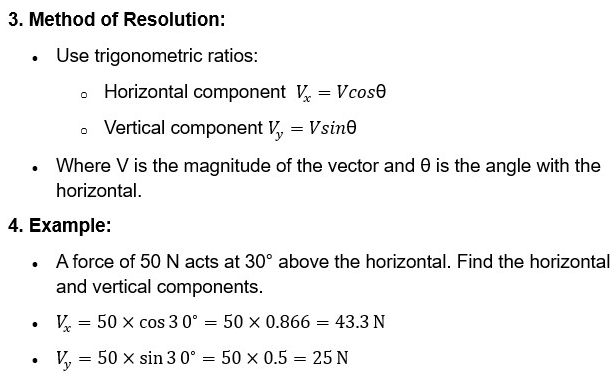
- Vector Resolution: Splitting a vector into two or more component vectors, usually perpendicular (commonly horizontal and vertical).
- Why Resolve Vectors?
- Simplifies calculation of effects in each direction.
- Essential in physics problems involving forces, velocity, etc.
Learners’ Activities
- Resolve a vector of 40 N acting at 45° into components.
- Draw vector and components on graph paper with scale.
- Group work: Resolve combined forces in a pulley system.
Consolidation (Review and Assessment) – 10 minutes
Oral Questions:
- Why do we resolve vectors?
- What formula do we use to find horizontal component?
- Calculate components of a 60 N force at 60°.
Homework / Assignment
- Resolve the following vectors into components:
a) 70 N at 20°
b) 100 N at 60° - Draw force diagrams showing components.
Notes – Detailed and Explained
- Resolution is crucial for understanding motion and forces in two dimensions.
- Components are perpendicular and independent; they can be analyzed separately.
- Trigonometric functions allow exact calculation of components.
- Mastery of vector resolution supports solving projectile motion and equilibrium problems.
Expanded Notes / Instructions
- Encourage use of calculators for trigonometric calculations.
- Practice sketching vectors accurately with protractors for better comprehension.
Inclusive / Differentiation
- Visual aids and hands-on drawing for spatial learners.
- Provide formula sheets for learners needing support.
- Group discussions to foster peer support.
Teacher’s Reflection (Post-Lesson Questions)
- Were learners able to resolve vectors accurately?
- Did the examples and activities aid understanding?
- How well did learners apply trigonometric concepts to physics problems?