Download the Lessonotes Mobile Liberia app for faster lesson access on Android and iPhone.


Subject: Physics
Semester: 2
Period: 5
Week: 29
School Name:
Teacher’s Name:
Subject: Physics
Grade Level: Grade 11
Week & Period: Week 29, Period V
Date:
Sub-topic: Vibrations in Strings and Tubes (Pipes) – Resonance and Beats
Learning Objectives:
By the end of the lesson, learners should be able to:
- Explain the concept of resonance and its applications.
- Describe vibrations in stretched strings and air columns.
- Calculate frequency and speed of sound in strings and pipes.
- Distinguish between open and closed pipes.
- Analyze the formation of beats and explain its use in tuning instruments.
Previous Knowledge:
Learners already understand wave properties, sound transmission, and pitch. They have been introduced to harmonics and wave speed relationships.
Instructional Materials:
- Tuning forks
- Resonance tubes (open and closed)
- Meter rules or graduated cylinders
- Stringed musical instrument or lab string apparatus
- Beakers, water, stopwatch
- Speakers and tone generator (app or device)
Anticipation (Warm-Up):
Ask:
- "Why does a guitar string sound different when you tighten it?"
- "Why does blowing into a bottle at different water levels change the pitch?"
Demonstrate a tuning fork placed over a water-filled resonance tube and observe sound amplification.
Building Knowledge (Main Lesson) – 25 minutes:
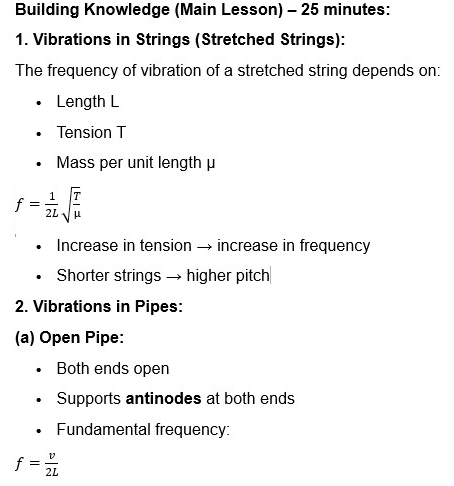
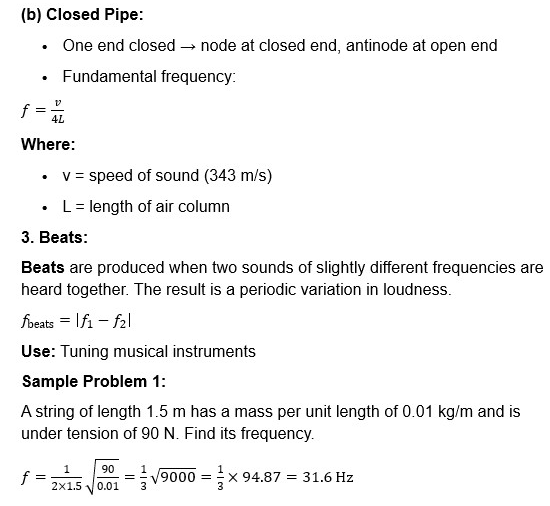
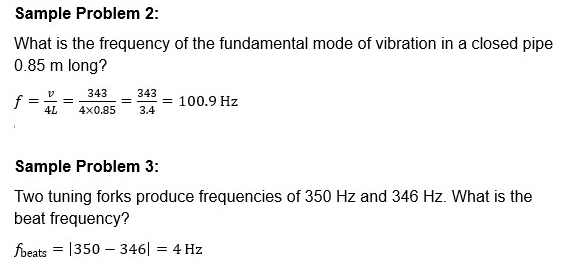
Learners’ Activities:
- Blow across different lengths of straw (pipes) and record pitch.
- Use tuning forks and water column to locate resonance points.
- Stretch strings with varying tension and record pitch.
- Simulate beats using tone generator app with two close frequencies.
Experiment:
Title: Demonstration of Beats and Resonance in Pipes
Materials:
- Two tuning forks of close frequency (e.g., 250 Hz & 252 Hz)
- Resonance tube (graduated cylinder with water)
- Beaker, ruler
Procedure:
- Strike both tuning forks and hold close to ear.
- Observe periodic loud-soft pattern (beats).
- Strike one fork and hold it over resonance tube with variable water level.
- Move tube until loudest sound is heard – this is the resonance length.
Observation:
- Beats heard as rise and fall in volume
- Loudest resonance occurs when pipe length matches natural frequency of fork
Assessment (Classwork):
- What is resonance? Mention one example from daily life.
- Calculate the fundamental frequency of a 1.2 m open pipe.
- What is the beat frequency between 440 Hz and 444 Hz tuning forks?
Homework / Assignment:
- Explain the role of harmonics in a guitar string.
- Draw diagrams of the fundamental and first overtone in open and closed pipes.
- How does string tension affect the frequency of sound produced?
Expanded Notes:
- Resonance is essential in musical instruments, bridges, and even microwave ovens.
- Closed and open pipes have different sound-producing behaviors due to boundary conditions.
- Beats are also used in acoustic tuning and hearing tests.
Differentiation:
- Diagrams and hands-on musical instruments for kinesthetic learners
- Step-by-step calculations for struggling learners
- Video clips of resonance and beats for visual learners
Teacher’s Reflection:
- Did learners understand the difference between open and closed pipes?
- Were they able to visualize and hear beats?
- Did string tension–frequency relationships make sense?