Download the Lessonotes Mobile Liberia app for faster lesson access on Android and iPhone.


Subject: Mathematics
Semester: 1
Period: 2
Week: 9
WEEK 9
Class: Grade 12
Age: 17 years
Duration: 40 minutes of 5 periods
Subject: Mathematics
Topic: Arithmetic of Finance II
Focus: Amortization, Bonds, Debentures, Shares, Income Tax, Value Added Tax (VAT), and Calculations using Logarithms
SPECIFIC OBJECTIVES:
By the end of the lesson, students should be able to:
- Define and compute amortization.
- Calculate interest on bonds and debentures using logarithms.
- Understand and calculate shares, rate of income tax, and value added tax (VAT).
- Solve problems in capital markets, including bonds, debentures, shares, taxes, and rates using logarithmic tables.
INSTRUCTIONAL TECHNIQUES:
- Question and answer
- Guided demonstration
- Problem-solving approach
- Practical exercises
- Case studies and discussions
INSTRUCTIONAL MATERIALS:
- Solution chart for compound interest
- Solution chart for bonds and debentures
- Logarithm table
- Charts for rates, taxes, and VAT calculations
- Visual aids or diagrams showing capital market processes
- Guest speaker (optional) from the stock exchange or inland revenue office
PERIOD 1: Introduction to Amortization and Capital Markets
PRESENTATION:
|
Step |
Teacher’s Activity |
Student’s Activity |
|
Step 1 - Introduction to Amortization |
Introduces the concept of amortization, explaining it as the process of gradually paying off a debt over time through regular payments. Demonstrates a basic amortization table. |
Students listen attentively and ask questions about the definition and concept of amortization. |
|
Step 2 - Concept of Capital Markets |
Introduces the types of capital market instruments: bonds, debentures, shares, and their relevance in real-world finance. |
Students engage by sharing what they know about bonds, debentures, and shares. |
|
Step 3 - Amortization Table |
Demonstrates how to calculate amortization using a sample loan (principal, rate, term). Shows the first few payments in an amortization schedule. |
Students take notes and follow the examples in the amortization calculation. |
|
NOTE ON BOARD: |
Amortization: The process of paying off debt through regular payments. |
|
|
EVALUATION (5 exercises): |
- Define amortization.
- What is the main difference between bonds and shares?
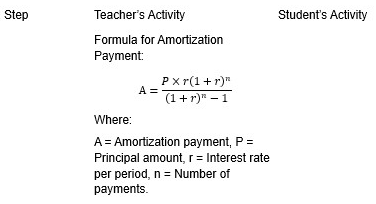
- How is amortization calculated?
- What is the formula for amortization?
- What is the role of capital markets in an economy?
CLASSWORK (5 questions):
- Calculate the monthly amortization for a loan of N100,000 at 5% annual interest for 3 years.
- What is the principal in an amortization formula if the payment is N12,000, the interest rate is 6%, and the loan term is 2 years?
- Give one real-world example where amortization is used.
- What is the effect of increasing the loan term on amortization payments?
- Calculate the total amount paid for a loan of N50,000 after 4 years with 8% annual interest, assuming monthly payments.
ASSIGNMENT (5 tasks):
- Research the differences between amortization and depreciation.
- Find an example of a company that issues bonds, and explain how the company calculates interest on the bonds.
- What does the rate of interest on a bond indicate about the market conditions?
- Explain how share prices are determined in the capital markets.
- Calculate the monthly payment for a loan of N150,000 at 7% annual interest for 5 years.
PERIOD 2: Calculation of Interest on Bonds and Debentures
PRESENTATION:
|
Step |
Teacher’s Activity |
Student’s Activity |
|
Step 1 - Introduction to Bonds and Debentures |
Explains bonds and debentures as long-term debt instruments issued by corporations or governments. Introduces the concept of interest on bonds. |
Students listen and take notes on the difference between bonds and debentures. |
|
Step 2 - Bond Interest Calculation |
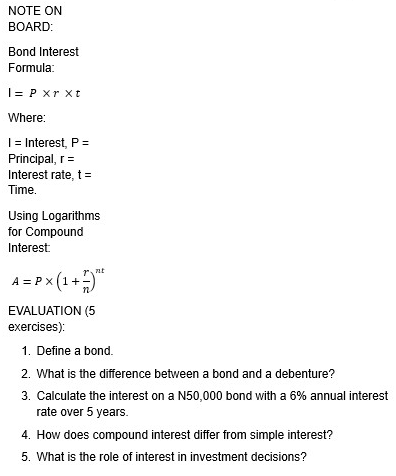
Demonstrates how to calculate the interest on bonds using the bond formula and logarithms for compound interest. |
Students follow along with the example calculation. |
|
Step 3 - Logarithm Table Usage |
Guides students through using a logarithm table to calculate interest and solve compound interest problems for bonds. |
Students practice using the logarithm table in pairs to calculate bond interest. |
CLASSWORK (5 questions):
- A bond has a principal of N100,000, an interest rate of 7% per annum, and a term of 3 years. Calculate the total interest.
- How much would you receive after 10 years on a N200,000 bond with 5% annual interest compounded annually?
- What is the maturity value of a bond with a 4% interest rate for 6 years on a N30,000 principal?
- Calculate the interest for a debenture of N50,000 at an interest rate of 8% for 4 years.
- A bond is sold at a 10% interest rate. What will be the interest after 2 years on N75,000?
ASSIGNMENT (5 tasks):
- Calculate the compound interest for a bond of N150,000 at 6% annual interest for 8 years.
- What are the advantages of issuing bonds over debentures?
- How do interest rates affect the price of a bond?
- What is the present value of a bond with a 5% interest rate and a principal of N200,000 after 7 years?
- Research the taxation of bond interest in your country and explain its implications.
EVALUATION (5 exercises):
- What is a share?
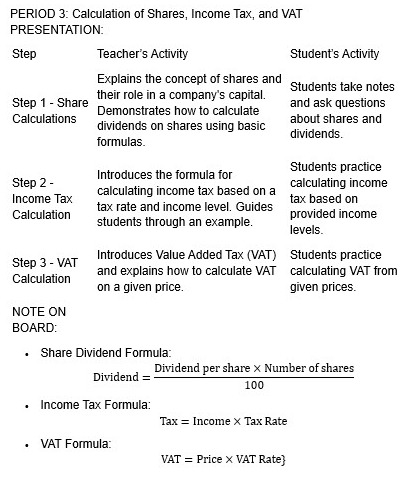
- Calculate the dividend for 100 shares if the dividend per share is N5.
- Calculate the income tax for a salary of N50,000 with a 10% tax rate.
- Calculate the VAT for a product priced at N200 with a 5% VAT rate.
- How does VAT affect consumer prices?
CLASSWORK (5 questions):
- Calculate the dividend for 200 shares with a dividend of N3 each.
- A person earns N80,000 monthly. Calculate their income tax at a 15% rate.
- Calculate VAT for an item priced at N500 with a VAT rate of 7%.
- If an individual earns N150,000 annually, calculate their income tax at a 20% rate.
- What is the price of a product including VAT if the price is N1,000 and the VAT rate is 10%?
ASSIGNMENT (5 tasks):
- Research the taxation rates for income and VAT in your country.
- Calculate the dividend for 500 shares with a dividend of N8 per share.
- Calculate the income tax for a salary of N120,000 at a 25% rate.
- Calculate the VAT for a product priced at N1,200 with a 12% VAT rate.
- Discuss the implications of income tax and VAT on businesses and consumers.
PERIOD 4: Application of Logarithms to Financial Problems
PRESENTATION:
|
Step |
Teacher’s Activity |
Student’s Activity |
|
Step 1 - Introduction to Logarithms in Finance |
Explains the importance of logarithms in solving financial problems such as compound interest and bond interest. |
Students listen and take notes on logarithms' role in finance. |
|
Step 2 - Guided Practice |
Provides sample problems for students to solve using logarithms, focusing on financial calculations. |
Students solve problems in groups or pairs with teacher guidance. |
|
Step 3 - Independent Practice |
Allows students to independently solve additional problems using logarithms. |
Students complete practice problems and seek assistance when needed. |
PERIOD 5: Review and Practical Problem Solving
PRESENTATION:
|
Step |
Teacher’s Activity |
Student’s Activity |
Step 1 - Recap of Key Concepts
Reviews the main points covered during the week: amortization, bonds, debentures, shares, taxes, VAT, and logarithms.
Students ask questions about any unclear concepts.
Step 2 - Group Problem Solving
Guides students through solving a comprehensive financial problem that integrates all topics covered.
Students work in groups to solve a complex problem.
Step 3 - Class Discussion
Facilitates a class discussion on real-life applications of the topics learned. Students engage in a discussion on the practical applications of mathematics in finance. |
EVALUATION: Students will complete both written exercises and practical problem-solving tasks to assess their understanding of the lesson content.
ASSIGNMENT (Final Task):
Solve a real-world financial problem involving amortization, bonds, shares, and income tax using the techniques learned in this unit. Provide a detailed report with all necessary calculations.