Download the Lessonotes Mobile Liberia app for faster lesson access on Android and iPhone.


Subject: Mathematics
Semester: 1
Period: 3
Week: 16
WEEK 16
Class: Grade 12
Age: 17 years
Duration: 40 minutes of 5 periods
Subject: Mathematics
Topic: Coordinate Geometry II
Focus: Gradient of a straight line and y-intercept, Equation of a straight line, Angle between two intersecting lines, Condition for parallel lines and perpendicular lines, Practical application of coordinate geometry.
SPECIFIC OBJECTIVES:
By the end of the lesson, students should be able to:
- Define and calculate the gradient of a straight line.
- Define and calculate the y-intercept of a straight line.
- Write the equation of a straight line.
- Calculate the angle between two intersecting straight lines.
- Identify the condition for parallel lines and perpendicular lines.
- Apply the concept of coordinate geometry to real-life situations.
INSTRUCTIONAL TECHNIQUES:
- Direct instruction
- Group discussions
- Problem-solving exercises
- Guided practice
- Real-life applications
INSTRUCTIONAL MATERIALS:
- Graph board
- Graph books
- Graph charts
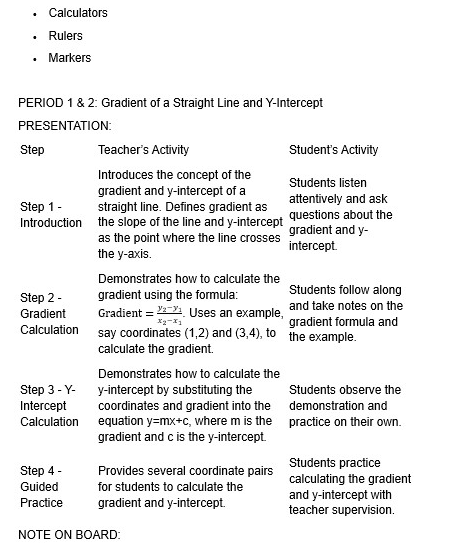
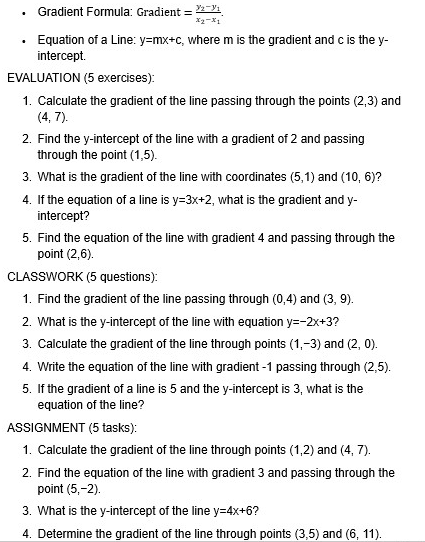
5. If the equation of a line is y=−x+4, find its gradient and y-intercept.
PERIOD 3 & 4: Equation of a Straight Line
PRESENTATION:
|
Step |
Teacher’s Activity |
Student’s Activity |
|
Step 1 - Introduction |
Explains the formula for the equation of a straight line: y=mx+c. Explains how to derive the equation using given points or gradient and y-intercept. |
Students pay attention and take notes on the equation of a straight line. |
|
Step 2 - Deriving Equation |
Works through examples with given coordinates to derive the equation of a straight line. For example, using the gradient and a point on the line to find the equation. |
Students observe the process and participate in solving an example. |
|
Step 3 - Guided Practice |
Provides exercises for students to derive the equations of lines from different forms, including using the gradient and a point. |
Students practice deriving equations individually and in pairs. |
NOTE ON BOARD:
Equation of a line: y=mx+c, where m is the gradient and c is the y-intercept.
EVALUATION (5 exercises):
- Derive the equation of the line with gradient 3 and passing through the point (1,2).
- Write the equation of the line passing through points (2,4) and (5, 10).
- Find the equation of a line with gradient -2 passing through the point (3,6).
- What is the equation of the line with gradient 5 and passing through the point (1,2)?
- Write the equation of the line passing through points (0,4) and (3, 7).
CLASSWORK (5 questions):
- Derive the equation of the line with gradient 1 and passing through the point (4,6).
- Write the equation of the line with gradient -3 and passing through the point (2,5).
- What is the equation of the line through points (1,3) and (2, 5)?
- Find the equation of the line with gradient 0 and passing through (2,3).
- Write the equation of the line with gradient 4 passing through the point (0,−1).
ASSIGNMENT (5 tasks):
- Find the equation of the line with gradient 2 passing through the point (1,5).
- Write the equation of the line with gradient -1 and passing through the point (2,3).
- What is the equation of the line passing through (0,1) and (3, 7)?
- Derive the equation of a line with gradient 4 and passing through the point (3,5).
- Write the equation of the line passing through the points (1,2) and (4, 8).
PERIOD 5: Angle Between Two Intersecting Lines and Application
PRESENTATION:
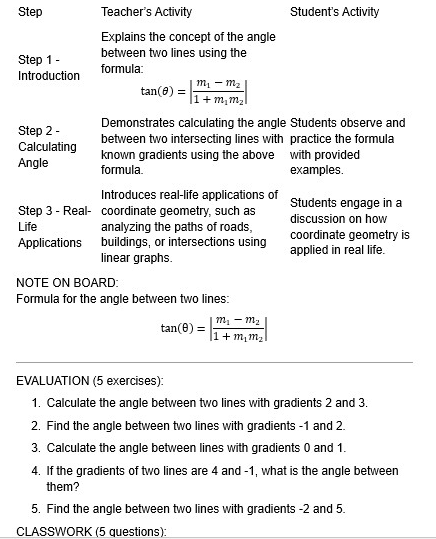
- Calculate the angle between two lines with gradients 1 and -2.
- What is the angle between lines with gradients 0 and 1?
- Find the angle between two lines with gradients -3 and 2.
- If two lines have gradients 1/2 and 3/4, what is the angle between them?
- Calculate the angle between two lines with gradients 2 and 5.
ASSIGNMENT (5 tasks):
- Find the angle between lines with gradients 1 and 2.
- Calculate the angle between two lines with gradients -2 and 4.
- What is the angle between two lines with gradients 1/3 and -1/2?
- Calculate the angle between two lines with gradients 2 and -3.
- Provide a real-life scenario where the angle between two intersecting lines is important.