Download the Lessonotes Mobile Liberia app for faster lesson access on Android and iPhone.


Subject: Mathematics
Semester: 2
Period: 4
Week: 19
WEEK 19
Class: Grade 12
Age: 17 years
Duration: 40 minutes x 5 periods
Subject: Mathematics
Topic: Differentiation II
Focus: Rules of Differentiation (Sum, Difference, Product, Quotient, Composite Functions), Application of Differentiation (Maxima, Minima, Acceleration, Velocity, Rate of Change)
SPECIFIC OBJECTIVES:
By the end of the lesson, students should be able to:
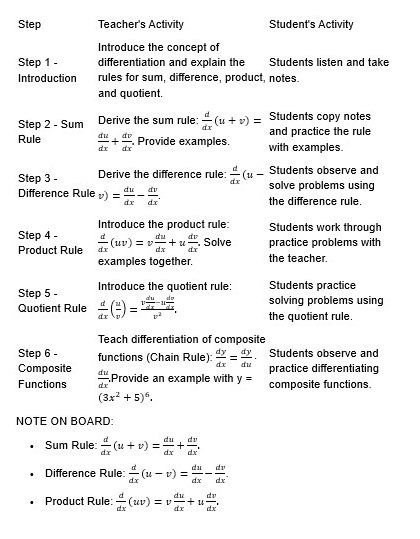
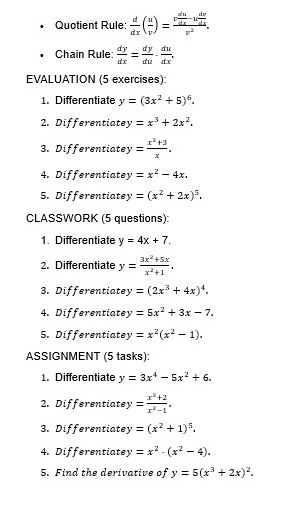
- Apply the rules of differentiation to functions.
- Differentiate functions involving sums, differences, products, quotients, and composite functions.
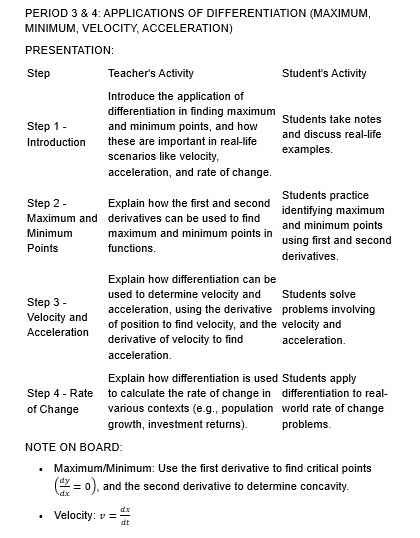
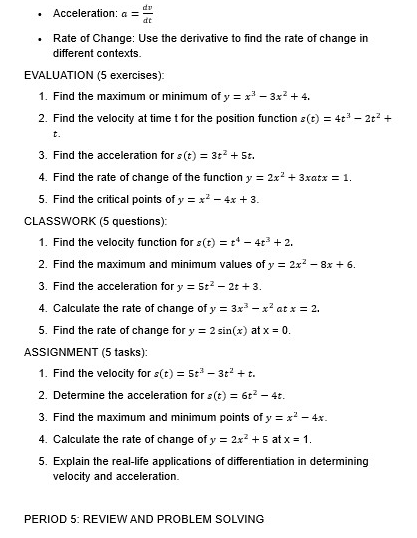
- Solve problems using differentiation to determine maximum and minimum points, as well as acceleration, velocity, and rate of change.
INSTRUCTIONAL TECHNIQUES:
- Direct instruction
- Guided practice
- Problem-solving
- Collaborative exercises
- Real-life applications (e.g., velocity, acceleration, rate of change)
INSTRUCTIONAL MATERIALS:
- Whiteboard and markers
- Standard derivative charts
- Computer-assisted instructional materials (optional)
PERIOD 1 & 2: RULES OF DIFFERENTIATION (SUM, DIFFERENCE, PRODUCT, QUOTIENT, COMPOSITE FUNCTIONS)
PRESENTATION:
PRESENTATION:
|
Step |
Teacher's Activity |
Student's Activity |
|
Step 1 - Review |
Review all the rules of differentiation and their applications. Answer any questions that students have. |
Students ask clarifying questions and review important points. |
|
Step 2 - Problem Solving |
Provide complex, real-life problems to solve using differentiation. Guide students through the process. |
Students work individually or in pairs to solve problems. |
|
Step 3 - Conclusion |
Summarize the key points from the lesson. Emphasize the importance of differentiation in solving real-life problems. |
Students take final notes and reflect on the applications of differentiation. |
EVALUATION:
- Solve a problem involving velocity and acceleration.
- Differentiate a composite function and apply the chain rule.
- Find the maximum and minimum points of a quadratic function.