Download the Lessonotes Mobile Liberia app for faster lesson access on Android and iPhone.


Subject: Physics
Semester: 2
Period: 4
Week: 19
School Name:
Teacher’s Name:
Subject: Physics
Grade Level: Grade 12
Week & Period: Week 19, Period IV
Date:
Main Topic: Alternating Current (AC) and Electronics
Sub-Topic: Introduction to Alternating Current (AC) – Measurements and Functions
Learning Objectives:
By the end of the lesson, learners should be able to:
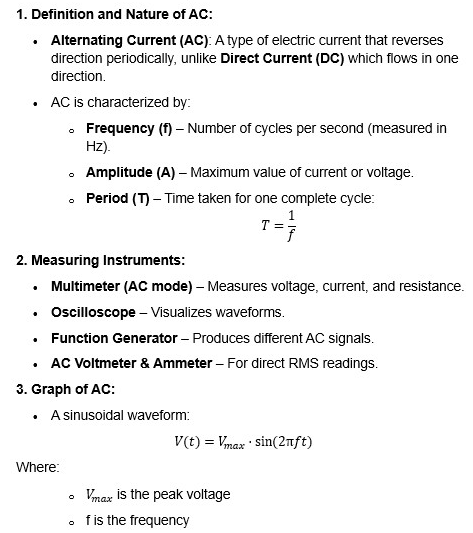
- Define alternating current and explain how it differs from direct current.
- Identify and describe electrical measuring instruments used with AC.
- Interpret AC waveforms (sine, frequency, amplitude, and period).
- Calculate RMS (Root Mean Square) and peak values of AC.
- Describe the importance and applications of alternating current in real-life situations.
Instructional Materials:
- AC power source (low voltage for safety)
- Oscilloscope
- Multimeter
- Function generator
- AC lamp
- Connecting wires
- Graph/chart paper
- Sample transformer
- Sine wave diagrams (printed or drawn)
Anticipatory Set (Warm-Up):
Begin by asking:
“Why do we use alternating current in homes and not batteries (DC)?”
Allow learners to respond, then display the output of an AC source on the oscilloscope screen and compare with DC output.
Building Knowledge (Main Lesson):
4. RMS and Peak Values:
- RMS (Root Mean Square) value gives the effective power value in AC:
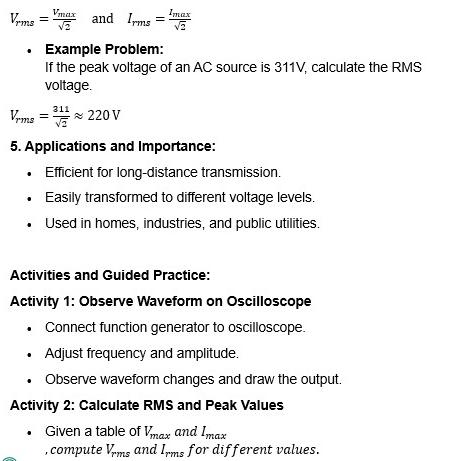
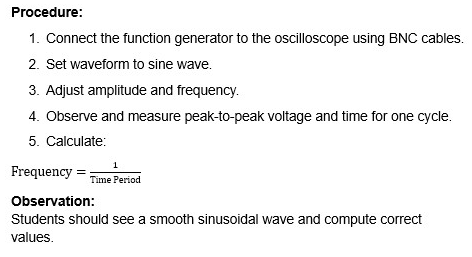
Experiment: Measuring AC Waveform with Oscilloscope
Objective: To measure the frequency and amplitude of an AC waveform.
Materials:
- Function generator
- Oscilloscope
- Connecting leads
Assessment:
Classwork:
- Define AC and list two ways it differs from DC.
- A current has a peak value of 5A. Find its RMS value.
- What is the function of an oscilloscope?
Homework:
- Draw and label one full cycle of a sine wave.
- Calculate the period of an AC source with frequency 50Hz.
- List three household devices powered by AC.
Expanded Notes:
- AC power is used in homes because it’s more efficient to transmit and transform.
- In Liberia and most of West Africa, AC mains supply is 220–240V at 50Hz.
- RMS is used because it equates the heating effect to an equivalent DC value.
Differentiation:
- Visual aids (graphs, oscilloscope demo) for visual learners.
- Hands-on experiments for kinesthetic learners.
- Formula charts and calculation guides for analytical learners.
Teacher’s Reflection:
- Were students able to understand sine waves and AC characteristics?
- Did the oscilloscope activity clarify the difference between peak and RMS?
- How can I incorporate more real-life examples of AC devices?