Download the Lessonotes Mobile Liberia app for faster lesson access on Android and iPhone.


Subject: Physics
Semester: 2
Period: 4
Week: 20
School Name:
Teacher’s Name:
Subject: Physics
Grade Level: Grade 12
Week & Period: Week 20, Period IV
Date:
Main Topic: Alternating Current and Electronics
Sub-Topic: AC Circuits – R, L, and C Components (Resistance, Inductance, and Capacitance)
Learning Objectives:
By the end of this lesson, learners should be able to:
- Identify and explain the behavior of R, L, and C in AC circuits.
- Define and calculate impedance in R, L, and C circuits.
- Analyze phase relationships between voltage and current in each component.
- Interpret and sketch phasor diagrams for RL, RC, and RLC circuits.
- Solve basic AC circuit problems involving impedance and current.
Instructional Materials:
- Function generator (AC power supply)
- Resistors, inductors, capacitors
- Multimeter
- Oscilloscope
- Connecting wires
- Graph/chart paper
- Sine wave diagrams
- AC ammeter and voltmeter
Anticipatory Set (Warm-Up):
Pose the question:
“When AC passes through a resistor and a coil, does it behave the same way as DC?”
Allow students to experiment briefly with an AC power source connected to a resistor and an inductor.
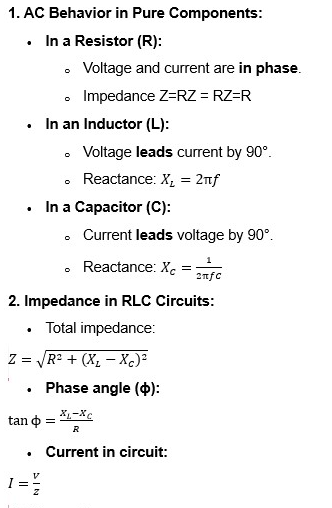
- Phasor Diagrams:
- Show vectors representing voltages across R, L, and C.
- Used to find resultant voltage and phase relationships.
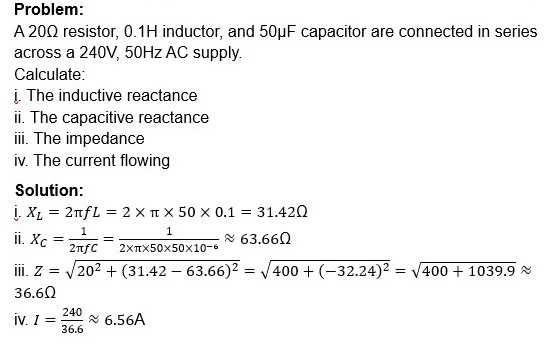
Solved Example Problem:
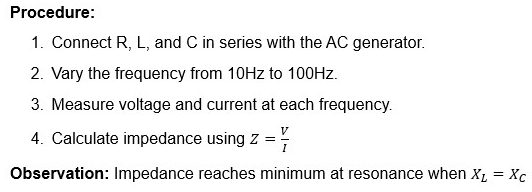
Experiment: Investigating Impedance in an RLC Circuit
Objective: To observe how impedance changes with frequency in an RLC circuit.
Materials:
- AC function generator
- Resistor (R)
- Inductor (L)
- Capacitor (C)
- Multimeter or oscilloscope
- Connecting leads
Activities and Guided Practice:
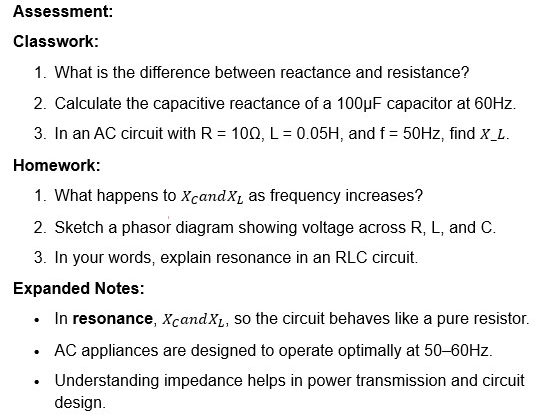
- Sketch and label phasor diagrams for:
- R circuit
- RL circuit
- RC circuit
- RLC circuit
- Compute impedance and current for various values of R, L, and C.
Differentiation:
- Group learners into teams to build simple RLC circuits.
- Visual learners can use animated simulations.
- Kinesthetic learners can measure actual voltages and currents with meters.
Teacher’s Reflection:
- Did students understand the concept of phase difference?
- Were they able to compute impedance correctly?
- How can I reinforce resonance practically?