Download the Lessonotes Mobile Liberia app for faster lesson access on Android and iPhone.


Subject: Physics
Semester: 2
Period: 5
Week: 26
School Name:
Teacher’s Name:
Subject: Physics
Grade Level: Grade 12
Week & Period: Week 26, Period V
Date:
Main Topic: Atomic and Nuclear Physics
Sub-topic: Types of Nuclear Reactions and the Uses of Nuclear Energy
Learning Objectives:
By the end of the lesson, learners should be able to:
- Define nuclear reactions and identify types.
- Distinguish between nuclear fission and nuclear fusion.
- State examples of isotopes involved in nuclear reactions.
- Discuss peaceful and harmful uses of nuclear energy.
- Solve simple problems involving energy released in nuclear reactions using Einstein’s equation.
Instructional Materials:
- Chart showing nuclear reaction equations
- Short documentary or animation on fission/fusion
- Diagram of a nuclear reactor
- Periodic table showing isotopes
- Einstein equation: E = mc²
Anticipation (Warm-Up):
“Have you ever wondered how a small amount of uranium can power an entire city—or destroy one?”
Ask learners: “What do you think happens when an atom splits or combines?”
Building Knowledge (Main Lesson):
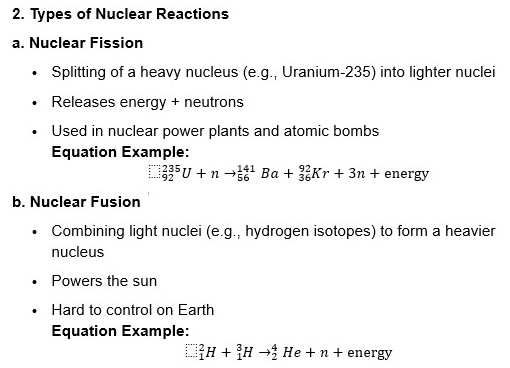
- What is a Nuclear Reaction?
- A nuclear reaction involves changes in an atom’s nucleus.
- It releases large amounts of energy due to mass-energy conversion.
- Isotopes in Nuclear Reactions
- Uranium-235, Plutonium-239 used in fission
- Deuterium (²H) and Tritium (³H) used in fusion
- Uses of Nuclear Energy
Peaceful Uses:
- Electricity generation
- Medical applications (e.g. radiotherapy)
- Agriculture (food preservation)
Harmful Uses:
- Nuclear weapons
- Radioactive waste
- Radiation poisoning
Demonstration (Video/Diagram):
Simulated Activity:
Use a chart/video to show a nuclear reactor:
- Fuel rods, control rods, moderator, coolant, turbine
- Describe energy generation from chain reaction in fission.
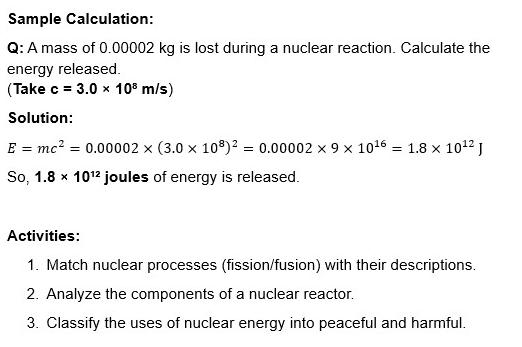
Sample Calculation:
Q: A mass of 0.00002 kg is lost during a nuclear reaction. Calculate the energy released.
(Take c = 3.0 × 10⁸ m/s)
Solution:
Assessment:
Classwork:
- Define fission and fusion with one example each.
- What are the benefits and dangers of nuclear energy?
- Calculate energy from mass loss of 0.001 kg.
Homework:
- Draw and label a simplified nuclear reactor.
- Explain why fusion releases more energy than fission.
Expanded Notes:
- Fusion is cleaner but technologically demanding.
- Radioactive waste remains hazardous for centuries.
- Countries must balance energy needs with safety.
- Small mass changes in nuclear reactions = massive energy release.
Differentiation:
- Visual: Diagrams of reactor and reactions
- Logical: Calculations with Einstein’s equation
- Auditory: Video explanations and class discussions
- Kinesthetic: Labeling parts of a model reactor
Teacher’s Reflection:
- Were learners able to differentiate fission from fusion?
- Did the reactor diagram help clarify the chain reaction?
- Could learners relate the concept of mass-energy equivalence to real life?