Download the Lessonotes Mobile Liberia app for faster lesson access on Android and iPhone.


Subject: Physics
Semester: 2
Period: 5
Week: 27
School Name:
Teacher’s Name:
Subject: Physics
Grade Level: Grade 12
Week & Period: Week 27, Period V
Date:
Main Topic: Atomic and Nuclear Physics
Sub-topic: Radioactivity
Focus Areas:
- Types of Radioactivity
- Radioactive Substances and Their Effects
- Radioactive Decay and Half-life
Learning Objectives:
By the end of the lesson, learners should be able to:
- Define radioactivity and identify natural and artificial sources.
- Differentiate between alpha, beta, and gamma radiation.
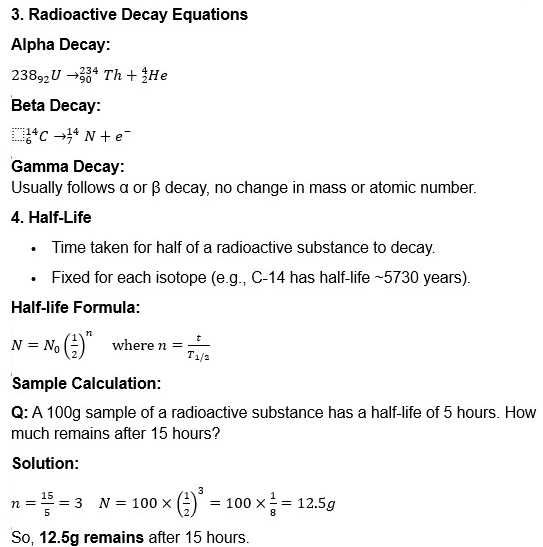
- Write nuclear equations for radioactive decay.
- Explain the concept of half-life and solve related problems.
- Discuss the health and environmental effects of exposure to radiation.
Instructional Materials:
- Radiation chart (α, β, γ)
- Nuclear decay equation samples
- Geiger-Müller counter (or video simulation)
- Isotope cards
- Decay graph for half-life
- Lead sheets, paper, and aluminum foil (for shielding demonstration)
Anticipation (Warm-Up):
“Some substances glow in the dark and give off energy invisibly. What kind of power is that?”
Ask learners if they’ve heard of radioactive substances like uranium or how X-rays can penetrate the body.
Building Knowledge (Main Lesson):
- What is Radioactivity?
- Radioactivity is the spontaneous disintegration of unstable atomic nuclei, releasing radiation.
- Discovered by Henri Becquerel; expanded by Marie and Pierre Curie.
- Can occur naturally (e.g., uranium, radon) or be artificial (produced in labs).
- Types of Radiation
|
Type |
Symbol |
Nature |
Charge |
Penetration |
Stopped by |
|
Alpha |
α |
2 protons + 2 neutrons |
+2 |
Low |
Paper, skin |
|
Beta |
β |
High-speed electrons |
-1 |
Medium |
Aluminum sheet |
|
Gamma |
γ |
Electromagnetic wave |
0 |
High |
Thick lead, concrete |
Health and Environmental Effects:
- Positive uses: Cancer treatment (radiotherapy), food sterilization, smoke detectors
- Negative effects: DNA damage, cancer, radiation burns, contamination of soil and water
Demonstration: Penetration Test (Simulated)
Materials: Radiation chart, diagrams, paper, foil, and lead blocks
Procedure: Simulate how different radiations penetrate materials using classroom visuals.
Activities:
- Write decay equations for common isotopes (e.g., Polonium-210).
- Calculate half-life problems using different scenarios.
- Role-play: Effects of radiation exposure in a nuclear plant accident.
Assessment:
Classwork:
- Define alpha, beta, and gamma radiation with one difference each.
- Solve: A 64g sample with half-life of 2 hrs remains 8g. How long has it decayed?
- Draw a table comparing the three types of radiation.
Homework:
- Research: Where is radiation used in hospitals and how is it controlled?
- Write a safety guide for handling radioactive materials.
Expanded Notes:
- Nuclear power relies on fission reactions using radioactive fuel.
- Radioactive dating uses decay rates to determine age of fossils and rocks.
- Proper shielding and storage reduce exposure risks.
Differentiation:
- Visual: Decay graphs, radiation comparison charts
- Logical: Step-by-step decay calculations
- Auditory: Radiation effects video/audio interviews
- Group: Simulated “nuclear lab” team projects
Teacher’s Reflection:
- Did students grasp the concept of decay and half-life clearly?
- Could they relate radiation to real-world examples?
- Were learners cautious and informed about safety concerns?