Download the Lessonotes Mobile Liberia app for faster lesson access on Android and iPhone.


Subject: Physics
Semester: 2
Period: 5
Week: 28
School Name:
Teacher’s Name:
Subject: Physics
Grade Level: Grade 12
Week & Period: Week 28, Period V
Date:
Main Topic: Atomic and Nuclear Physics
Sub-topic: Nuclear Fission and Fusion
Learning Objectives:
By the end of the lesson, learners should be able to:
- Define and differentiate between nuclear fission and nuclear fusion.
- Write and interpret nuclear equations for both processes.
- Discuss the energy transformations involved in fission and fusion.
- Analyze advantages, disadvantages, and safety concerns of nuclear energy.
- Identify applications of fission and fusion in power generation and weapons.
Instructional Materials:
- Charts/Diagrams of nuclear fission and fusion
- Sample fission and fusion equations
- Video/simulation of chain reactions
- Globe or map showing nuclear power plants
- Projector or flashcards
- Hydrogen and Uranium models (optional)
Anticipation (Warm-Up):
Ask: “Which is more powerful—splitting an atom or combining two atoms? Why do you think so?”
Display two short animations: one of fission and one of fusion. Discuss students' observations.
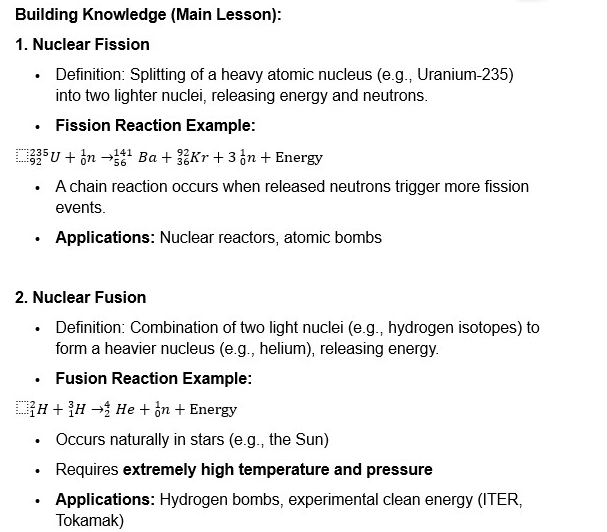
Building Knowledge (Main Lesson):
- Nuclear Fission
- Definition: Splitting of a heavy atomic nucleus (e.g., Uranium-235) into two lighter nuclei, releasing energy and neutrons.
- Fission Reaction Example:
- A chain reaction occurs when released neutrons trigger more fission events.
- Applications: Nuclear reactors, atomic bombs
- Nuclear Fusion
- Definition: Combination of two light nuclei (e.g., hydrogen isotopes) to form a heavier nucleus (e.g., helium), releasing energy.
- Fusion Reaction Example:
- Occurs naturally in stars (e.g., the Sun)
- Requires extremely high temperature and pressure
- Applications: Hydrogen bombs, experimental clean energy (ITER, Tokamak)
- Key Differences Between Fission and Fusion
|
Feature |
Fission |
Fusion |
|
Process |
Splitting of nucleus |
Combining of nuclei |
|
Example Nuclei |
Uranium, Plutonium |
Hydrogen, Deuterium, Tritium |
|
Energy Released |
High |
Very High |
|
By-products |
Radioactive waste |
Few radioactive products |
|
Occurs Naturally |
Rare |
In stars |
|
Controlled Use |
Nuclear reactors |
Under development (future tech) |
- Safety Concerns and Challenges
- Fission:
- Long-term radioactive waste
- Risk of meltdown (e.g., Chernobyl, Fukushima)
- Fusion:
- Requires advanced containment (magnetic or inertial)
- Not yet commercially viable
Experiment/Activity (Simulated):
Title: Simulating Chain Reactions
Materials: Mouse traps + ping pong balls (or dominos)
Procedure:
- Set mouse traps close together with balls on them.
- Drop one extra ball.
- Observe chain reaction.
This represents how one neutron can trigger multiple fission reactions.
Sample Calculation:
Q: If 1 kg of U-235 undergoes complete fission, estimate the energy released given that each fission releases ~200 MeV.
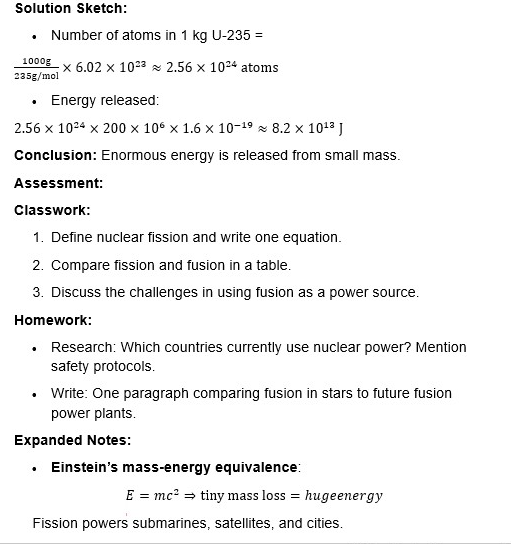
- Fusion promises clean energy without radioactive waste.
Differentiation:
- Visual: Simulations and chart comparisons
- Kinesthetic: Chain reaction demonstration
- Analytical: Half-life and energy release calculations
- Group: Design posters on safe nuclear power plants
Teacher’s Reflection:
- Were students able to clearly differentiate fission and fusion?
- Could they explain why fusion is harder to achieve practically?
- Did the simulation help visualize a chain reaction?