Download the Lessonotes Mobile Liberia app for faster lesson access on Android and iPhone.


Subject: Physics
Semester: 2
Period: 5
Week: 29
School Name:
Teacher’s Name:
Subject: Physics
Grade Level: Grade 12
Week & Period: Week 29, Period V
Date:
Main Topic: Atomic and Nuclear Physics
Sub-topic: Thermionic and Photoelectric Emissions; Cathode Rays and X-rays
Learning Objectives:
By the end of the lesson, learners should be able to:
- Define and differentiate between thermionic and photoelectric emissions.
- Explain the working principles of cathode ray tubes (CRT) and X-ray tubes.
- State and apply the photoelectric equation.
- Discuss the uses and dangers of cathode rays and X-rays.
- Solve related numerical problems involving threshold frequency and energy.
Instructional Materials:
- Diagrams of cathode ray tube and X-ray tube
- Electron gun model (or picture)
- Light source and metal plate (for simulating photoelectric effect)
- Power supply and heating filament (for thermionic emission demo)
- Multimedia projector (optional)
- Aluminum foil, zinc plate, electroscope (if demo is possible)
Anticipation (Warm-Up):
Ask: “Why does an old TV screen glow when powered, even before any channel appears?”
Lead into a discussion about electron movement and emissions.
Building Knowledge (Main Lesson):
- Thermionic Emission:
- Definition: The release of electrons from a heated metal surface.
- Used in cathode ray tubes (CRT), vacuum tubes, X-ray tubes.
Conditions Required:
- High temperature
- Low pressure
- Emitting surface (usually metallic filament)
- Photoelectric Emission:
- Definition: Emission of electrons when light of certain frequency strikes a metal surface.
- Einstein’s Photoelectric Equation:
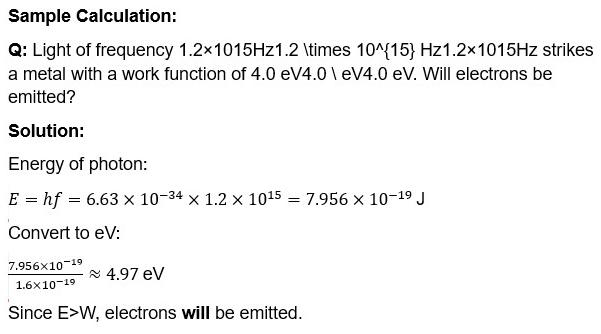
E=hf=W+KE
Where:
- E = Energy of incident photon
- h = Planck’s constant
- f = Frequency of light
- W = Work function of the metal
- KE = Kinetic energy of emitted electron
- Cathode Rays:
- Electrons emitted from a heated cathode in a vacuum tube and accelerated toward an anode.
- Properties:
- Negatively charged
- Travel in straight lines
- Can be deflected by electric and magnetic fields
- Cause fluorescence on impact
Applications:
- CRT (used in old TVs and oscilloscopes)
- Electron microscopes
- X-Rays:
- Produced when high-speed electrons strike a metal target (anode) inside an X-ray tube.
- Penetrates soft tissue but absorbed by bones and dense materials.
Types:
- Hard X-rays: High energy, short wavelength (medical imaging)
- Soft X-rays: Lower energy, used in industrial testing
Dangers:
- Ionizing radiation
- Can damage tissues and cause mutations
Experiments & Demonstrations:
- Photoelectric Effect Simulation
Materials: Zinc plate, UV light source, electroscope
Procedure:
- Charge a zinc plate negatively and place it on an electroscope.
- Shine UV light on the plate.
- Observe the electroscope discharge as electrons are ejected.
- Thermionic Emission
Materials: Filament lamp, power supply
Procedure:
- Apply current to a filament to heat it.
- Demonstrate electron release (visible as glow or deflection in a cathode ray setup)
Assessment:
Classwork:
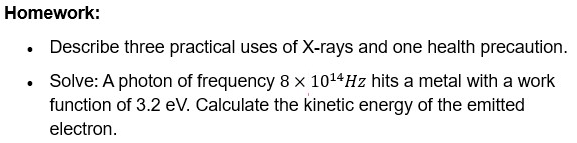
- Define thermionic and photoelectric emissions.
- Draw a labeled diagram of a cathode ray tube.
- State two properties of cathode rays.
Expanded Notes:
- Cathode rays led to the discovery of the electron by J.J. Thomson.
- Photoelectric effect supports the quantum nature of light.
- X-rays are also used in airport security, industry, and crystallography.
Differentiation:
- Use simulations and animations for abstract concepts.
- Provide step-by-step calculations for math-focused students.
- Group projects: build or sketch simple cathode ray devices.
Teacher’s Reflection:
- Did learners grasp the photoelectric principle and its application in solar panels?
- Were demonstrations effective in visualizing abstract concepts?
- Could students differentiate between emission types and their real-world applications?