Download the Lessonotes Mobile Liberia app for faster lesson access on Android and iPhone.


Subject: Physics
Semester: 1
Period: 2
Week: 9
School Name:
Teacher’s Name:
Subject: Physics
Grade Level: Grade 12
Week & Period: Week 9, Period II
Date:
Topic: Direct Current (DC) Circuits
Sub-topics:
- Series Circuits
- Parallel Circuits
- Series-Parallel Combinations
Learning Objectives:
By the end of the lesson, learners should be able to:
- Identify and differentiate between series and parallel circuit arrangements.
- Analyze the flow of current, voltage, and resistance in both circuit types.
- Solve circuit problems involving series, parallel, and mixed resistors.
- Construct and test simple DC circuits.
- Discuss the advantages and limitations of each configuration.
Instructional Materials:
- Dry cells or battery packs
- Resistors of known values
- Switches
- Connecting wires
- Breadboard or circuit board
- Ammeter and voltmeter
- Multimeter
- Bulbs
Anticipation (Warm-Up):
Ask learners:
“What happens when one bulb in a Christmas light goes out?”
Use this to introduce the concepts of series vs parallel arrangements.
Building Knowledge (Main Lesson):
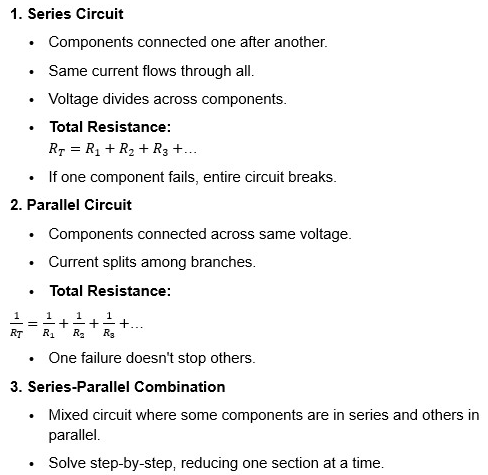
Demonstrations & Activities:
Activity A:
Constructing a Series Circuit
- Connect three resistors (e.g., 2Ω, 4Ω, 6Ω) in series to a battery.
- Measure total voltage, current through each resistor, and total resistance.
Activity B:
Constructing a Parallel Circuit
- Use same resistors (2Ω, 4Ω, 6Ω) in parallel.
- Measure voltage across each and total current.
Activity C:
Constructing a Series-Parallel Circuit
- Two resistors in parallel, then combined in series with another resistor.
- Observe and analyze using multimeter.
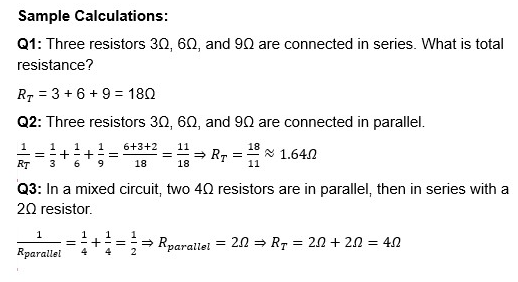
Assessment Questions:
- Objective Questions
- In a parallel circuit, which quantity remains the same across all branches?
A. Current
B. Resistance
C. Voltage
D. Power - Total resistance in a series connection is:
A. The smallest resistor
B. The sum of all resistors
C. The largest resistor
D. Zero
- Short Answer Questions
- State two differences between series and parallel circuits.
- Why are most household electrical circuits wired in parallel?
- Problem Solving
A 12V battery is connected to three resistors of 2Ω, 4Ω, and 6Ω:
i. What is the total resistance in series?
ii. What current flows through the circuit?
iii. What is the voltage drop across each resistor?
Homework:
- Design your own home lighting plan using parallel connections.
- Solve: Two 3Ω resistors are in parallel. A 6Ω resistor is added in series. Find total resistance.
Expanded Notes:
- Series circuits are simple but failure-prone.
- Parallel circuits are used in buildings to ensure functionality even if one device fails.
- Multimeters are essential tools to diagnose and analyze circuits.
- DC circuits form the foundation of electronics and power supply systems.
Differentiation:
- Group work to build and analyze each circuit type
- Circuit diagrams for visual learners
- Real-world applications for contextual learners
Teacher’s Reflection:
- Did learners distinguish clearly between current and voltage behavior?
- Were they able to calculate total resistance for all three types?
- Did hands-on circuit building reinforce understanding?