Download the Lessonotes Mobile Liberia app for faster lesson access on Android and iPhone.


Subject: Physics
Semester: 1
Period: 2
Week: 11
School Name:
Teacher’s Name:
Subject: Physics
Grade Level: Grade 12
Week & Period: Week 11, Period II
Date:
Topic: Electrical Energy and Power; Heating Effects; Electrolysis; Kirchhoff’s Laws
Sub-topics:
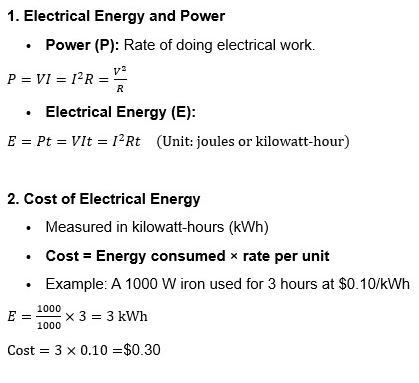
- Electrical Energy and Power
- Cost of electrical energy
- Heating effect of current (Joule’s Law)
- Electrolysis
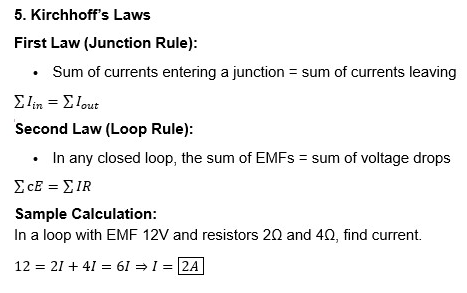
- Kirchhoff’s Laws of Electric Circuits
Learning Objectives:
By the end of the lesson, learners should be able to:
- Define electrical energy and power and relate them with resistance and current.
- Calculate electrical energy consumption and cost.
- State and apply Joule’s Law of heating.
- Analyze basic electrolysis principles and applications.
- State and apply Kirchhoff’s First and Second Laws to solve simple circuits.
Instructional Materials:
- Electric heater or bulb
- Ammeter and Voltmeter
- Stopwatch
- Electrolysis setup (electrolyte, electrodes, DC power source)
- Copper sulfate solution
- Copper and carbon electrodes
- Wires, multimeter
- Chart showing electricity bill
Anticipation (Warm-Up):
Ask: “Why does your electric bill increase when you use a heater or iron more frequently?”
Discuss learners’ experiences with appliances and power consumption.
Building Knowledge (Main Lesson):
- Heating Effect (Joule’s Law)
- Heat produced:
H=I2RtH = I^2RtH=I2Rt
- Used in heaters, irons, toasters.
- Energy is converted into heat when current flows through resistance.
Demonstration: Connect a coil to power source and measure temperature rise over time.
- Electrolysis
- Decomposition of an electrolyte using DC current.
- Example: Electrolysis of copper (II) sulfate using copper electrodes.
- Faraday’s Laws (briefly introduced): Amount of substance deposited is proportional to current × time.
Experiment:
Title: Electrolysis of CuSO₄ solution
Materials:
- DC power source
- Copper sulfate solution
- Copper electrodes
- Ammeter, stopwatch, wires
Procedure:
- Connect copper electrodes in solution.
- Connect to DC source with ammeter in series.
- Switch on and observe deposition of copper on cathode.
Observation: Copper is deposited on cathode, anode dissolves.
Assessment Questions:
- Objective Questions
- Which of these is a unit of electrical energy?
A. Watt
B. Joule
C. Ampere
D. Volt - Joule’s Law shows that heat depends on:
A. Resistance only
B. Current only
C. Current and resistance
D. Voltage and charge
- Short Answer
- State Kirchhoff’s First and Second Laws.
- What is the formula for power in terms of voltage and resistance?
- Problem Solving
- A 60W bulb is used for 5 hours daily for 30 days. What is the energy consumed and cost if 1kWh = $0.15?
- A current of 3A flows through a wire of resistance 5Ω for 10 minutes. Calculate the heat produced.
- In a circuit loop with EMF = 18V and two resistors (3Ω and 6Ω), find the current.
Homework:
- Explain why electrical heating devices have coils with high resistance.
- Calculate the energy used by a 1500W heater used for 2 hours daily in 20 days.
Expanded Notes:
- Electrolysis is used in purification of metals and electroplating.
- Kirchhoff’s Laws are essential for analyzing complex circuits.
- Electricity bills are calculated from energy in kWh and unit cost.
Differentiation:
- Visuals and charts for slow learners
- Practical circuit analysis for fast learners
- Worksheets with varying difficulty levels
Teacher’s Reflection:
- Did learners understand energy vs power?
- Were Kirchhoff’s laws correctly applied?
- Did all students actively participate in experiments?