Download the Lessonotes Mobile Liberia app for faster lesson access on Android and iPhone.


Subject: Physics
Semester: 1
Period: 3
Week: 16
School Name:
Teacher’s Name:
Subject: Physics
Grade Level: Grade 12
Week & Period: Week 16, Period III
Date:
Topic: Electromagnetic Induction
Sub-Topic: Laws of Electromagnetic Induction; Induced Current and EMF
Learning Objectives:
By the end of the lesson, learners should be able to:
- Explain electromagnetic induction and its discovery by Faraday.
- State and explain Faraday’s and Lenz’s Laws of Electromagnetic Induction.
- Identify factors affecting the magnitude of induced EMF.
- Describe how to induce current using a magnet and coil.
- Solve problems on induced EMF using relevant equations.
Instructional Materials:
- Bar magnets
- Copper wire (solenoid)
- Galvanometer or ammeter
- Iron core
- Rheostat
- Power source
- Circuit board or breadboard
- Diagrams of electromagnetic induction setups
Anticipation (Warm-Up Activity):
Ask:
“Can you light a bulb without using a battery?”
Demonstrate: Connect a coil to a galvanometer and move a magnet in and out of the coil.
Observe the needle deflection.
Building Knowledge (Main Lesson):
- What is Electromagnetic Induction?
Electromagnetic induction is the process of generating an electric current in a conductor by changing the magnetic field around it. 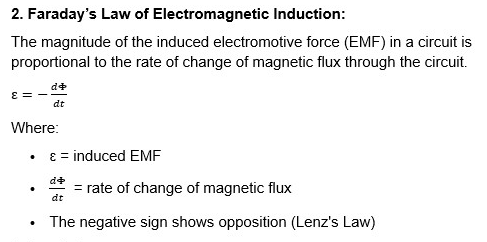
- Lenz’s Law:
The direction of induced current is such that it opposes the change that produced it.
This is a consequence of the Law of Conservation of Energy.
- Methods of Inducing Current:
- Moving a magnet through a coil
- Moving a coil through a magnetic field
- Changing the magnetic field around a stationary coil
- Factors Affecting Induced EMF:
- Speed of relative motion
- Strength of the magnetic field
- Number of turns in the coil
- Area of the coil
Activities/Experiment:
Experiment 1: Inducing Current with a Magnet
Materials: Coil of wire, galvanometer, bar magnet
Procedure:
- Connect coil to galvanometer
- Move magnet into coil
- Observe deflection
- Reverse magnet direction and repeat
Observation:
Current is induced. Direction of current changes with direction of magnet movement.
Experiment 2: Varying Coil Turns
Materials: Galvanometer, magnet, coils with different turns
Procedure:
- Repeat experiment above with coils of 10, 50, and 100 turns
Observation:
Greater number of turns → larger deflection → greater EMF
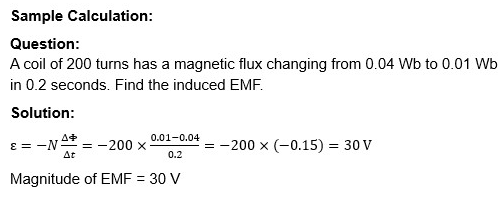
Sample Calculation:
Question:
A coil of 200 turns has a magnetic flux changing from 0.04 Wb to 0.01 Wb in 0.2 seconds. Find the induced EMF.
Solution:
Assessment (Class Work):
- Define electromagnetic induction.
- State Faraday’s Law.
- Describe two ways to induce current in a coil.
- A coil of 100 turns experiences a change in magnetic flux from 0.06 Wb to 0.01 Wb in 0.5 seconds. Calculate the EMF induced.
- What is the significance of the negative sign in Faraday’s law?
Homework:
- Explain how electromagnetic induction is used in electric generators.
- Draw a simple diagram showing induced current using a magnet and coil.
- Compare Faraday’s and Lenz’s laws in a table.
Expanded Notes:
- Electromagnetic induction is the basic working principle behind generators, transformers, and induction cookers.
- Induced EMF does not require physical contact—just magnetic interaction.
- Lenz’s Law ensures the system does not violate energy conservation.
Differentiation:
- Simulations and animations of coil-magnet interactions
- Real experiments for kinesthetic learners
- Faraday's discovery story for contextual understanding
Teacher’s Reflection:
- Were learners able to explain both laws clearly?
- Did they link the negative sign to energy conservation?
- Were the practical demonstrations effective in showing the concept?