Download the Lessonotes Mobile Liberia app for faster lesson access on Android and iPhone.


Subject: Physics
Semester: 1
Period: 3
Week: 17
School Name:
Teacher’s Name:
Subject: Physics
Grade Level: Grade 12
Week & Period: Week 17, Period III
Date:
Topic: Electromagnetic Induction
Sub-Topic: Inductors, Generators, Motors, and Transformers
Learning Objectives:
By the end of the lesson, learners should be able to:
- Define and explain the function of inductors.
- Differentiate between electric generators and electric motors.
- State the working principles of motors and generators.
- Describe the structure and operation of a transformer.
- Distinguish between step-up and step-down transformers.
- Solve basic calculation problems involving transformer efficiency and voltage/current ratios.
Instructional Materials:
- Simple inductor coil
- DC motor kit
- AC generator model
- Laminated iron core
- Primary and secondary coil wires
- Power source
- Multimeter or galvanometer
- Connecting leads and resistors
- Transformer diagram charts
Anticipation (Warm-Up Activity):
Ask:
“How does a fan spin with electricity while a generator gives electricity when spun?”
Display simple motor and generator models. Let learners observe motion and current generation.
Building Knowledge (Main Lesson):
- Inductors
- Devices that store energy in magnetic fields when current flows through them.
- Symbol: L, Unit: Henry (H)
- Applications: in filters, tuning circuits, and transformers.
- Electric Generator
- Converts mechanical energy → electrical energy using electromagnetic induction.
- Principle: Faraday’s Law
- Components: rotor, stator, magnets, coils
- Types:
- AC Generator (Alternator): Produces alternating current.
- DC Generator: Produces direct current (uses a commutator).
- Electric Motor
- Converts electrical energy → mechanical energy
- Principle: Force on a current-carrying conductor in a magnetic field
- Types:
- AC Motors
- DC Motors
Key Difference:
- Generator: motion → electricity
- Motor: electricity → motion
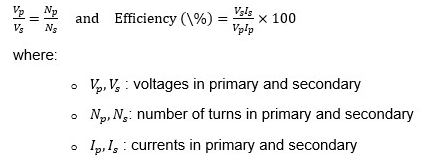
- Transformer
- Device that changes the voltage of AC.
- Step-up: increases voltage
- Step-down: decreases voltage
- Works on mutual induction (changing current in primary → induces voltage in secondary coil)
- Formula:
Activities/Experiments:
Experiment: Step-Up vs Step-Down Transformer
Materials: Laminated iron core, insulated wire, voltmeter, AC source
Procedure:
- Wind two coils on opposite sides of iron core
- Connect primary coil to AC source
- Connect voltmeter across secondary coil
- Measure voltage with different turn ratios
Observation: - More turns in secondary → voltage increases (step-up)
- Fewer turns in secondary → voltage decreases (step-down)
Experiment: Demonstrating Motor vs Generator
Motor Setup:
- Connect DC supply to coil in magnetic field → coil rotates
Generator Setup:
- Rotate coil in magnetic field → connect to galvanometer → needle deflects
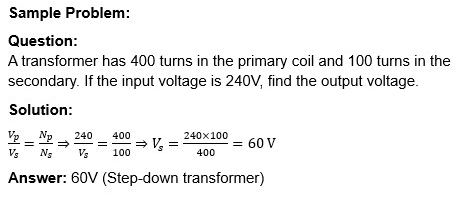
Sample Problem:
Question:
A transformer has 400 turns in the primary coil and 100 turns in the secondary. If the input voltage is 240V, find the output voltage.
Solution:
Assessment (Class Work):
- What is the major function of an inductor?
- Differentiate between AC and DC generators.
- A transformer has 800 turns in the primary and 200 in the secondary. If 220V is supplied to the primary, find the output voltage.
- Explain why transformers cannot work with DC.
- List two differences between a motor and a generator.
Homework:
- Draw a labeled diagram of a step-up transformer.
- Compare the working principles of a motor and a generator in a tabular format.
- A step-up transformer has a 2:1 turn ratio and receives 100V. What’s the output voltage?
Expanded Notes:
- Transformers rely on alternating current to create varying magnetic flux.
- Motors are used in blenders, fans, cars; generators in power plants.
- Inductors resist changes in current, useful in circuits with voltage surges.
- Efficiency in real transformers is affected by heat, core type, coil resistance.
Differentiation:
- Use animations to show the difference between step-up and step-down
- Allow students to simulate transformer coil winding
- Visual analogies for inductors as "shock absorbers" in current flow
Teacher’s Reflection:
- Were learners able to relate theory to the practical models?
- Did they accurately apply the transformer equations?
- Was the difference between motors and generators clearly understood?