Download the Lessonotes Mobile Liberia app for faster lesson access on Android and iPhone.


Subject: Physics
Semester: 1
Period: 2
Week: 10
School Name:
Teacher’s Name:
Subject: Physics
Grade Level: Grade 12
Week & Period: Week 10, Period II
Date:
Topic: Electromotive Force (EMF) and Internal Resistance
Sub-topics:
- Electromotive Force (EMF)
- Internal Resistance of a cell
- Terminal potential difference
- Calculations involving EMF and internal resistance
Learning Objectives:
By the end of the lesson, learners should be able to:
- Define electromotive force (EMF) and internal resistance.
- Distinguish between terminal potential difference and EMF.
- State the relationship between EMF, internal resistance, and terminal voltage.
- Solve circuit problems involving EMF and internal resistance.
- Perform an experiment to determine internal resistance of a cell.
Instructional Materials:
- Dry cell or battery
- Ammeter
- Voltmeter
- Variable resistor (rheostat)
- Key/switch
- Connecting wires
- Multimeter
- Calculator
- Load resistor
Anticipation (Warm-Up):
Ask: “Why does the brightness of a bulb decrease when the battery gets old?”
Guide learners to understand energy losses inside a battery due to internal resistance.
Building Knowledge (Main Lesson):
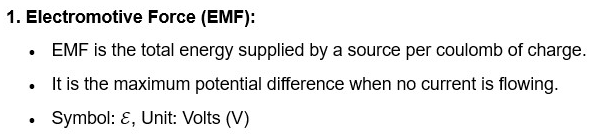
- Internal Resistance (r):
- The resistance offered by the materials inside the battery or cell.
- Causes a drop in voltage when current flows.
- Represented as a small resistor inside the battery in circuit diagrams.
- Terminal Potential Difference (V):
- The voltage measured across the terminals of a battery when current is flowing.
- Relationship:
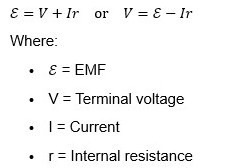
Experiment: Determining Internal Resistance of a Cell
Materials: Cell, Ammeter, Voltmeter, Variable resistor, Switch, Connecting wires
Procedure:
- Connect the circuit with a cell, ammeter, and variable resistor in series.
- Place the voltmeter across the terminals of the cell.
- Vary the resistance and record different values of current and corresponding terminal voltage.
- Plot a graph of terminal voltage (V) vs current (I).
- The y-intercept gives EMF, and the negative slope gives internal resistance.
Observation:
As current increases, terminal voltage drops.
Conclusion:
Internal resistance opposes current flow inside the battery, reducing output voltage.
Sample Calculations:
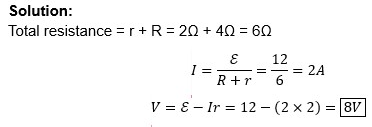
Q1: A battery of EMF 12V has internal resistance of 2Ω. It is connected to an external resistance of 4Ω. Calculate:
i. Total current
ii. Terminal voltage
Assessment Questions:
- Objective Questions
- Internal resistance of a battery causes:
A. Increase in EMF
B. Decrease in voltage under load
C. Increase in current
D. Constant terminal voltage - EMF of a battery is:
A. Measured only during charging
B. The voltage across its terminals when current flows
C. The energy per unit charge
D. Equal to resistance × voltage
- Short Answer Questions
- Define EMF and state its unit.
- Why is terminal voltage less than EMF when a battery is connected in a circuit?
- Problem Solving
A cell has EMF 9V and internal resistance 1Ω. It is connected to a lamp of resistance 5Ω.
i. Find the total current
ii. Find the terminal voltage
iii. How much voltage is lost inside the cell?
Homework:
- Draw and label a circuit diagram showing EMF, internal resistance, and external resistor.
- Solve: A 1.5V cell has internal resistance 0.5Ω. What current flows if connected to a 2Ω resistor?
Expanded Notes:
- Internal resistance increases as batteries age.
- High internal resistance causes devices to perform poorly.
- Terminal voltage can be measured using a multimeter under load.
Differentiation:
- Step-by-step graph plotting for visual learners
- Circuit assembly for hands-on practice
- Group work and discussion for collaborative learners
Teacher’s Reflection:
- Did learners correctly interpret the relationship between EMF and terminal voltage?
- Were graphs drawn accurately and internal resistance identified from slope?
- Did all learners successfully complete the calculation and experimental steps?