Download the Lessonotes Mobile Liberia app for faster lesson access on Android and iPhone.


Subject: Physics
Semester: 2
Period: 6
Week: 31
School Name:
Teacher’s Name:
Subject: Physics
Grade Level: Grade 12
Week & Period: Week 31, Period VI
Date:
Topic: High Energy Physics
Sub-topic: Quantum Mechanics
Learning Objectives:
By the end of this lesson, learners should be able to:
- Explain the basic postulates of quantum theory.
- State and apply the Heisenberg Uncertainty Principle.
- Describe the quantum numbers and their significance.
- Solve problems involving quantum energy levels.
- Relate the wave-particle duality to electron motion.
Instructional Materials:
- Animated simulations or slides on atomic orbitals
- Electron energy level chart
- Diffraction grating and monochromatic light (for wave demonstration)
- Meter rule
- Planck constant charts
- Scientific calculator
Anticipation (Warm-Up):
Pose the question:
“If light behaves like a wave, why can it knock out electrons from a metal?”
Allow students to discuss and debate before introducing wave-particle duality.
Building Knowledge (Main Lesson):
- Introduction to Quantum Mechanics:
- Classical physics fails to explain behaviors at the atomic level.
- Quantum mechanics deals with the behavior of matter and light on the atomic and subatomic scale.
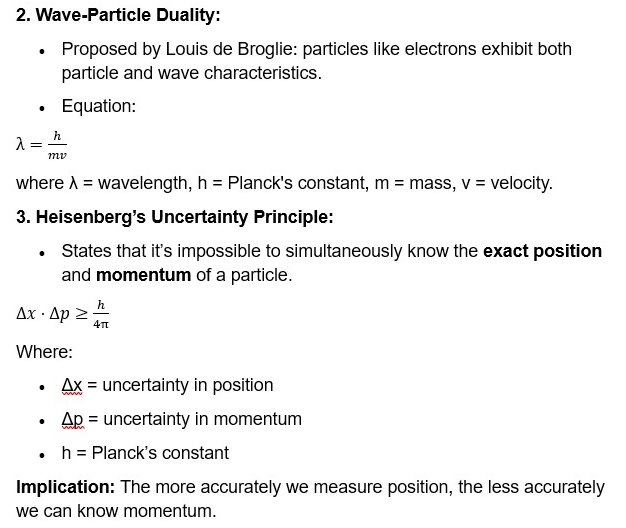
- Quantum Numbers:
Quantum numbers describe properties of electrons in atoms:
- Principal (n): Energy level/shell (n = 1, 2, 3…)
- Angular Momentum (l): Subshell type (s, p, d, f)
- Magnetic (m): Orientation of orbital
- Spin (s): Electron spin direction (+½ or –½)
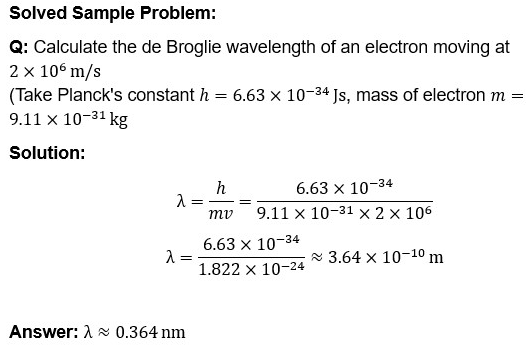
Experiment Demonstration: Electron Diffraction
Objective: To show wave nature of electrons using diffraction
Materials:
- Electron diffraction tube
- High-voltage power supply
- Safety gloves
- Viewing screen
Procedure:
- Set up the electron tube and apply voltage.
- Observe the diffraction ring patterns formed on the screen.
- Compare with predicted values using de Broglie’s formula.
Conclusion: Electrons show wave properties when passing through a slit or crystal structure.
Assessment:
Classwork Questions:
- State Heisenberg’s Uncertainty Principle.
- What is the wavelength of a 0.1 kg object moving at 10 m/s?
- List and define the four quantum numbers.
Homework:
- Draw and label energy levels for hydrogen atom (n = 1 to 4)
- Explain the role of quantum numbers in determining electron configuration
Expanded Notes (For Teacher’s Use):
- The uncertainty principle is foundational in nuclear physics and quantum chemistry.
- Quantum theory helps explain the stability of atoms.
- Energy levels are quantized: electrons can only occupy specific orbits.
Differentiation:
- Visual learners: Diagrams of orbitals and wave-particle duality
- Kinesthetic learners: Build atom models using colored balls and strings
- Auditory learners: Guided class reading of Einstein’s explanation of the photoelectric effect
Teacher’s Reflection:
- Did learners understand how electrons behave differently than large-scale objects?
- Could students relate quantum principles to real-world applications like lasers and semiconductors?