Download the Lessonotes Mobile Liberia app for faster lesson access on Android and iPhone.


Subject: Physics
Semester: 2
Period: 6
Week: 32
School Name:
Teacher’s Name:
Subject: Physics
Grade Level: Grade 12
Week & Period: Week 32, Period VI
Date:
Topic: High Energy Physics
Sub-topic: Particle Accelerators
Learning Objectives:
By the end of the lesson, learners should be able to:
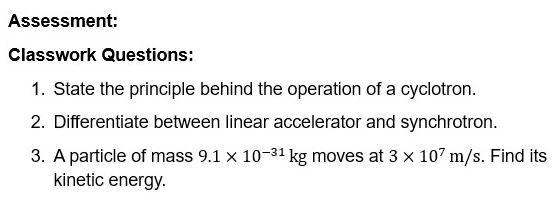
- Define a particle accelerator and state its function.
- Identify and distinguish between the types of particle accelerators.
- Describe how charged particles are accelerated using electric and magnetic fields.
- Explain the uses of particle accelerators in research and medicine.
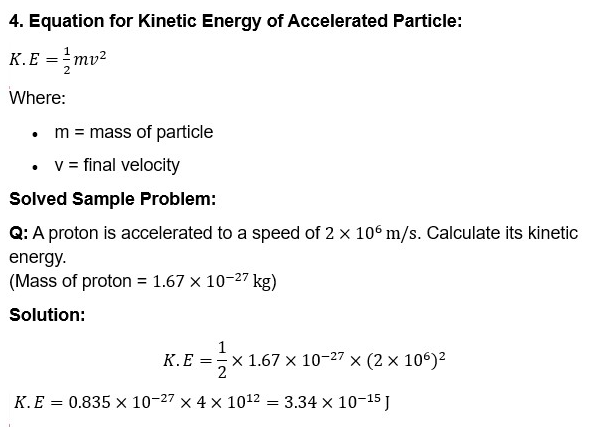
- Solve basic problems involving kinetic energy of accelerated particles.
Instructional Materials:
- Diagrams of cyclotron and linear accelerator
- Multimedia simulation (if available)
- Circular plastic tubing (model of cyclotron)
- DC power source
- Magnet (for visual demonstration)
Anticipation (Warm-Up):
Ask:
“How can scientists make particles like protons move near the speed of light?”
Let students brainstorm before revealing the use of particle accelerators.
Building Knowledge (Main Lesson):
- Introduction to Particle Accelerators:
- Devices used to accelerate charged particles (like protons or electrons) to high speeds using electric and magnetic fields.
- Used in physics research, cancer treatment, and creating new particles.
- Types of Particle Accelerators:
- Linear Accelerator (Linac):
- Particles are accelerated in a straight line using alternating electric fields.
- Example: used in X-ray generation and medical therapies.
- Cyclotron:
- Circular accelerator where particles spiral outward in increasing orbits.
- Uses a perpendicular magnetic field and alternating voltage between “D” shaped electrodes.
- Synchrotron:
- A modern version of the cyclotron with varying magnetic field and fixed orbit.
- Used in large research facilities like CERN.
- Basic Principle of Acceleration:
- Electric field provides energy to charged particles, increasing their kinetic energy.
- Magnetic field bends the path, keeping particles in circular motion (cyclotron).
Experiment Demonstration: Simple Cyclotron Model
Objective: To demonstrate circular particle motion with a magnetic field
Materials:
- Circular plastic tubing (to simulate particle path)
- Small ball bearing (to represent charged particle)
- DC power source
- Horseshoe magnet
- Oscilloscope or LED (for output detection)
Procedure:
- Connect the DC supply to the ends of the plastic loop.
- Insert the ball bearing and place the magnet to provide a magnetic field.
- Observe movement of the ball as current is passed.
Conclusion: Magnetic fields can guide and bend particle paths.
Homework:
- Draw labeled diagrams of a cyclotron and a linear accelerator.
- Explain why particles must move in circular paths in cyclotrons.
Expanded Notes:
- Particle accelerators are used to create high-energy collisions in physics experiments.
- They help discover new particles (e.g., the Higgs boson).
- Medical applications include radiation therapy to treat cancer (using linacs).
Differentiation:
- Visual learners: Animated diagrams of cyclotron
- Kinesthetic learners: Model-building of particle paths
- Auditory learners: Short podcast-style explanation of accelerator history
Teacher’s Reflection:
- Were students able to understand the purpose and function of particle accelerators?
- Could learners distinguish between linear, cyclotron, and synchrotron?
- Were real-world applications clearly understood?