Download the Lessonotes Mobile Liberia app for faster lesson access on Android and iPhone.


Subject: Physics
Semester: 2
Period: 6
Week: 33
School Name:
Teacher’s Name:
Subject: Physics
Grade Level: Grade 12
Week & Period: Week 33, Period VI
Date:
Topic: High Energy Physics
Sub-topic: Detecting Instruments
Learning Objectives:
By the end of this lesson, learners should be able to:
- Identify the various instruments used in detecting subatomic particles.
- Describe the principle and operation of each instrument.
- Explain how particle tracks are analyzed.
- Discuss the role of detectors in modern physics and nuclear research.
Instructional Materials:
- Chart or slide showing types of particle detectors
- Multimedia animation of cloud chamber, bubble chamber, and Geiger counter
- Model of a Geiger-Müller tube (if available)
- Ball and track demonstration for ionization paths
Anticipation (Warm-Up):
Ask:
“How can we detect particles that we cannot see or touch?”
Let students brainstorm and guide them into discussing ionization and trails left by high-energy particles.
Building Knowledge (Main Lesson):
- Introduction to Particle Detection:
Subatomic particles (electrons, protons, alpha particles, etc.) are invisible to the naked eye.
To study them, physicists use special instruments that can:
- Detect presence
- Track their path
- Measure energy and momentum
- Types of Particle Detectors:
- Cloud Chamber:
- Chamber filled with supersaturated vapor
- When a charged particle passes, it ionizes the gas and leaves behind visible condensation trails
How it works:
- Alcohol vapor condenses along the ionized path left by particles
- Appears as a thin mist trail
- Bubble Chamber:
- Superheated liquid (usually hydrogen) is used
- Charged particles leave bubble trails along their path
- Bubble size and curvature indicate energy and momentum
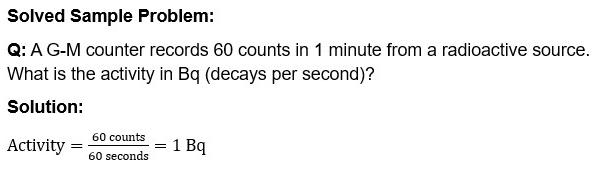
- Geiger-Müller (G-M) Counter:
- Detects ionizing radiation (alpha, beta, gamma)
- When radiation enters the tube, it ionizes gas inside
- A current pulse is generated and counted as a "click"
- Scintillation Detector:
- Uses crystals like sodium iodide
- Radiation hits the crystal → emits light → detected by photomultiplier tube
- Key Concepts:
- Ionization: The process of knocking off electrons from atoms
- Track curvature: In magnetic fields, charged particles follow curved paths
- Detection: Based on visible effects (condensation, light, bubbles, current)
Experiment Demonstration: DIY Cloud Chamber (Conceptual)
Objective: To demonstrate particle detection principles
Materials:
- Sealed transparent container
- Felt soaked in alcohol
- Dry ice
- Flashlight
- Dark room
Procedure:
- Line the container base with dry ice.
- Place alcohol-soaked felt on the top inside cover.
- Seal and wait for supersaturation to occur.
- Shine flashlight from the side.
Observation: Ionizing particles form visible mist trails.
Assessment:
Classwork Questions:
- State two differences between a cloud chamber and a bubble chamber.
- What is the principle of operation of a Geiger-Müller counter?
- Why is ionization important in particle detection?
Homework:
- Draw a diagram of a cloud chamber and label all parts
- Explain the role of a magnetic field in analyzing particle motion in detectors
Expanded Notes:
- Detectors are central to discoveries in particle physics.
- Cloud and bubble chambers are primarily used in labs and research.
- G-M counters are used in nuclear safety and medical diagnostics.
- Scintillation detectors are used in PET scans and gamma imaging.
Differentiation:
- Visual learners: Use particle trail simulations
- Kinesthetic learners: Track path activity using marbles and powder trails
- Auditory learners: Listen to G-M counter clicks in different radiation intensities
Teacher’s Reflection:
- Were students able to visualize how particles leave traces?
- Did learners understand the need for detection devices in nuclear studies?
- Did the experiment successfully link abstract theory with real-world instrumentation?