Download the Lessonotes Mobile Liberia app for faster lesson access on Android and iPhone.


Subject: Physics
Semester: 2
Period: 6
Week: 34
School Name:
Teacher’s Name:
Subject: Physics
Grade Level: Grade 12
Week & Period: Week 34, Period VI
Date:
Topic: High Energy Physics
Sub-topic: Subatomic Reactions
Learning Objectives:
By the end of this lesson, learners should be able to:
- Define and explain subatomic reactions.
- Identify the particles involved in subatomic reactions.
- Distinguish between different types of subatomic interactions.
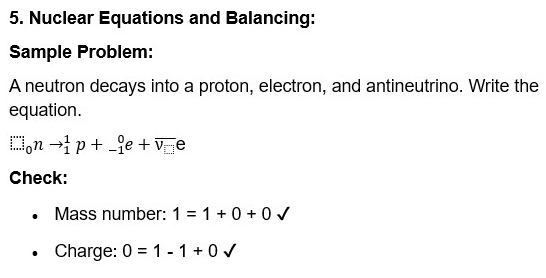
- Apply conservation laws (mass-energy, charge, baryon number, etc.) in solving subatomic reaction problems.
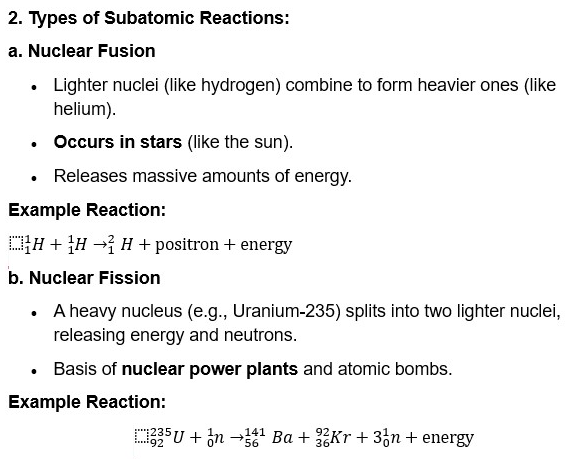
- Describe fusion and fission reactions in terms of subatomic particle exchanges.
Instructional Materials:
- Atomic model charts
- Flashcards for protons, neutrons, electrons, neutrinos, quarks
- Multimedia animations of fission and fusion
- Poster showing subatomic reactions in stars and reactors
- Worksheets with nuclear equations
Anticipation (Warm-Up):
Ask:
“What do you think happens inside an atom when it undergoes a nuclear change like fission or fusion?”
Discuss briefly and connect to previous knowledge of the nucleus.
Building Knowledge (Main Lesson):
- What are Subatomic Reactions?
- Subatomic reactions involve changes at the level of protons, neutrons, and electrons.
- These reactions occur inside atomic nuclei and result in energy release or transformation of elements.
- Fundamental Particles in Reactions:
- Protons, neutrons, electrons
- Neutrinos: Tiny neutral particles
- Quarks: Building blocks of protons and neutrons
- Antiparticles: Positrons (e⁺), antiprotons
- Laws Governing Subatomic Reactions:
- Conservation of Mass-Energy
- Conservation of Charge
- Conservation of Baryon Number
- Conservation of Lepton Number
NOTE: These laws must hold true for every nuclear or subatomic reaction.
Activities:
- Group learners to balance nuclear equations.
- Watch a visual simulation of fission and fusion reactions.
- Use particle flashcards to simulate reaction exchanges.
- Solve sample questions on subatomic reactions.
Experiment (Demonstration): Simulated Chain Reaction (Fission Concept)
Materials:
- Mousetraps
- Table tennis balls
- Tray
Procedure:
- Set many mousetraps on a tray, each holding a ball.
- Drop one ball onto the tray.
- Observe chain reaction as traps go off.
Observation:
Replicates how one neutron can trigger a series of fission events.
Assessment:
Classwork:
- What is the difference between fusion and fission?
- List any two particles involved in subatomic reactions.
- State two conservation laws that govern subatomic reactions.
Homework:
- Describe the role of the sun in fusion reactions.
- Draw and label a fission reaction showing neutron production.
Expanded Notes:
- Subatomic reactions are responsible for the energy of stars, nuclear weapons, and modern power stations.
- Research in subatomic reactions has led to medical technologies (PET scans) and exploration in quantum physics.
Differentiation:
- Visual learners: Use charts and simulations.
- Auditory learners: Group discussions on reaction types.
- Kinesthetic learners: Interactive flashcard-based games simulating reactions.
Teacher’s Reflection:
- Did learners understand how different particles interact?
- Were students able to balance nuclear equations effectively?
- How well did students relate theoretical reactions to real-world applications?