Download the Lessonotes Mobile Liberia app for faster lesson access on Android and iPhone.


Subject: Physics
Semester: 2
Period: 6
Week: 35
School Name:
Teacher’s Name:
Subject: Physics
Grade Level: Grade 12
Week & Period: Week 35, Period VI
Date:
Topic: High Energy Physics
Sub-topic: Einstein’s Photoelectric Equation
Learning Objectives:
By the end of this lesson, learners should be able to:
- Define the photoelectric effect.
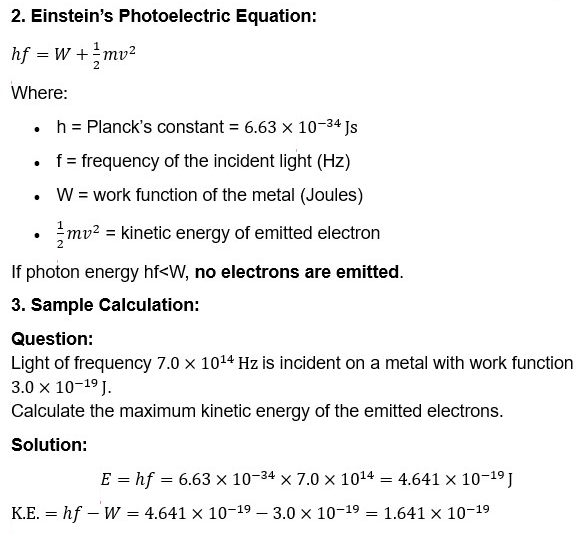
- State Einstein’s photoelectric equation and explain its components.
- Apply the equation to solve numerical problems.
- Describe how the photoelectric effect supports quantum theory.
- List materials used in photoelectric devices and discuss their applications.
Instructional Materials:
- Torchlight or UV lamp
- Metal plates (e.g., zinc or cesium-coated)
- Electroscope
- Digital voltmeter
- Batteries and wires
- Flashcards of formulae
- Charts of the electromagnetic spectrum
Anticipation (Warm-Up):
Ask:
“Can light really knock electrons off a metal? What does that say about the nature of light?”
Use this to introduce the concept that light behaves like both a wave and a particle.
Building Knowledge (Main Lesson):
- What is the Photoelectric Effect?
- It is the ejection of electrons from a metal surface when light of certain frequency shines on it.
- The phenomenon cannot be explained by the wave theory of light.
Key Concept: Light is made of packets called photons, each carrying energy E=hf
- Applications of the Photoelectric Effect:
- Solar cells
- Light meters in cameras
- Automatic doors
- Motion detectors
- Photoemissive devices
Activities:
- Shine UV light on a zinc plate connected to an electroscope to observe charge loss.
- Solve multiple problems involving Einstein’s equation.
- Research presentation: “How solar panels use photoelectric effect.”
Experiment (Demonstration):
Title: Observing the Photoelectric Effect with an Electroscope
Materials:
- Zinc plate
- UV lamp
- Gold-leaf electroscope
Procedure:
- Charge the zinc plate with negative charge (via rubbing or contact).
- Direct UV light onto the plate.
- Observe leaf collapse.
Observation:
Electrons are ejected → Electroscope discharges → Photoelectric effect confirmed
Assessment:
Classwork:
- Define the photoelectric effect.
- State Einstein’s photoelectric equation.
- List two practical uses of the photoelectric effect.

Expanded Notes:
- Classical physics expected brighter light to cause electron emission, but only frequency matters.
- This supports the quantum theory: energy is quantized.
- Threshold frequency: minimum frequency to eject electrons from a specific metal.
Differentiation:
- Use animations and real objects for visual learners.
- Step-by-step problem solving for analytical learners.
- Experiment demonstrations for kinesthetic learners.
Teacher’s Reflection:
- Were learners able to grasp the particle nature of light?
- Did students successfully apply Einstein’s equation in calculations?
- Were all learners able to relate the photoelectric effect to real-life devices?